Tuesday, May 22, 2012

Coastal habitat restoration at Stratford Point continues

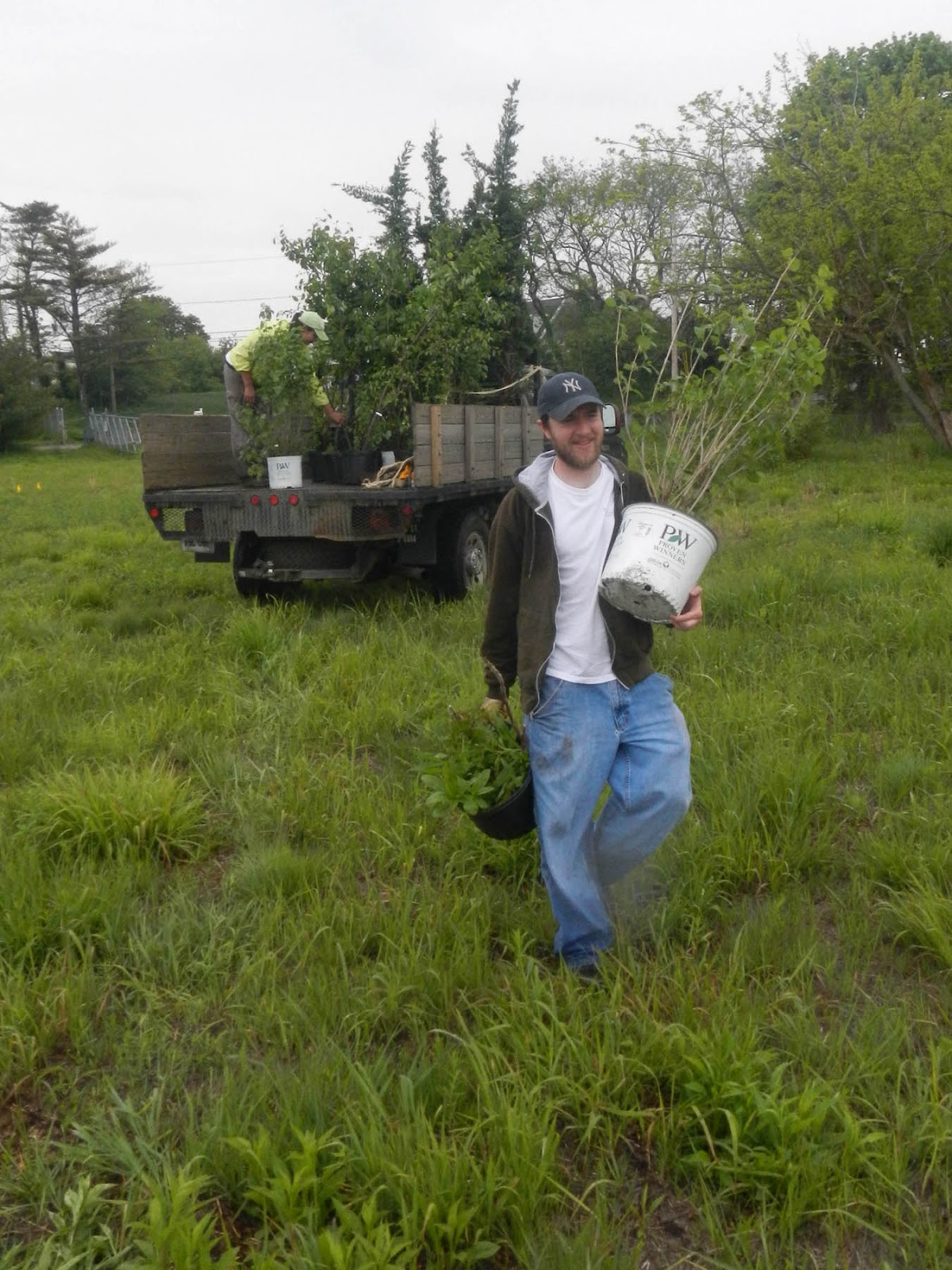
Last week students and staff from Sacred Heart University's Biology Department joined Connecticut Audubon Society staff at Stratford Point for a day of planting. Almost 100 native trees and shrubs, acquired through funding from the Connecticut Corporate Wetlands Restoration Partnership and the Connecticut Ornithological Association, were planted in the site's upland in an effort to enhance the coastal habitat and provide food, shelter and other resources for local wildlife.  

Habitat management of the remediated upland recently involved a prescribed burn to remove a thatch layer that had been building for several years. Encroaching invasive plant species are tackled as they crop up and last week's planting session is a next step towards fighting the unwanted and unsuited plants in the area and gradually replacing them with native vegetation that historically would have occurred in the area.    
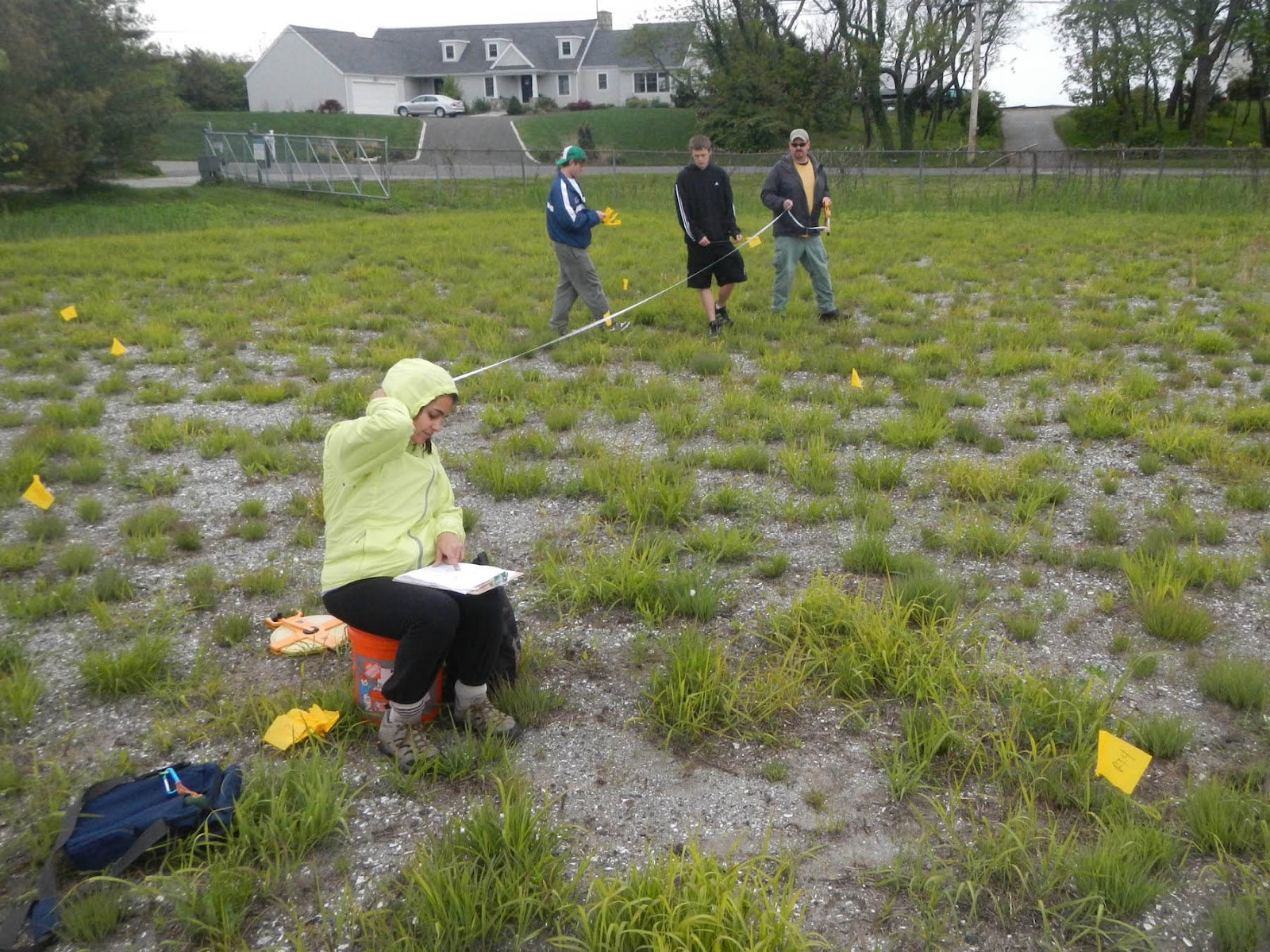


SHU graduate student Jennifer Gazerro provides directions to her crew as they stake out the exact locations of the new plantings in one of the four vegetation 'islands'

Previous vegetation surveys at Stratford Point during the summer of 2011 have provided a solid baseline assessment of the habitat prior to all the work that is being done, while similar surveys in high quality coastal habitat at our coastal center on Milford Point help us understand what a desired restoration outcome could be. Hopefully the new plants will put us another step closer to re-creating a functional coastal habitat.

Native trees and shrub, such as Red Bearberry (Arctostaphylos uva-ursi), Eastern Red Cedar (Juniperus virginiana), Serviceberry/Shadbush (Amelanchier canadensis), Southern Arrowwood (Viburnum dentatum), Hackberry (Celtis occidentalis), Northern Bayberry (Myrica pensylvanica), Beach Plum (Prunus maritima) and Staghorn Sumac (Rhus typhina), were planted in four identical, circular vegetation 'islands.' This configuration allows us to carry out specific monitoring studies to compare the well-being of plants in each 'island' as a result of different environmental conditions. In addition, it is easier to protect  clusters of vegetation rather than scattered individual plants from deer browsing.
          
Sacred Heart University students work hard to dig a large enough hole to accommodate the tree that CAS Sanctuary Manager John Laiacone is bringing over.  

CAS Conservation Technician Scott Kruitbosch is distributing shrubs to their designated spots
 Some additional plantings will take place in late summer/fall after we have carried out some contouring in the terrain to create a foundation for a back dune system that can trap wind-blown sediment. We're also hoping to create a temporary wetland on-site that can provide additional stop-over habitat for migrating birds. The remaining plantings will be applied to these projects to further enhance the habitat.    


The SHU Biology Department van was turned into a green delivery vehicle
A soil/compost mixture left over from the dune construction project carried out earlier this year is used as planting medium for the new trees


Many hands made the planting project manageable and by the end of the day all 96 trees and shrubs were in the ground
Luckily the rain and overcast weather in the past few days have provided perfect conditions for the new plants to catch on and we'll be watching and watering them as the summer progresses. Stratford Point's appearance is rapidly changing and we're hoping that our ongoing monitoring will reveal that these changes have a positive effect on the local flora and fauna. Come see for yourself sometime!    


Twan Leenders
Conservation Biologist

All photos © Twan Leenders and not to be reproduced without explicit permission

Monday, May 21, 2012

Larsen Sanctuary walk on 5/19

I joined CAS Director of Education, Michelle Eckman, as she led a spring bird walk through the Larsen Sanctuary at our CAS Center in Fairfield on Saturday morning. Michelle is not only a brilliant educator but also an excellent birder, helping all to observe birds by both sight and sound, the latter being a very important skill at this time of year.

I meant to take more photos but I became way too caught up in finding birds! Here is a shot of the group looking for a singing Red-eyed Vireo.


These are our full results with my notes on what was seen and/or heard.

Canada Goose  1     Flyover, heard
Double-crested Cormorant  1     Flyover, seen briefly
Red-shouldered Hawk  1     Chased by AMCR a couple times
Red-tailed Hawk  6     Seen all
Rock Pigeon  1     Seen flying by
Mourning Dove  3     Seen on building
Chimney Swift  4     Pairs seen/heard in a couple spots
Ruby-throated Hummingbird  1     Seen early in parking lot
Red-bellied Woodpecker  6     Seen and heard
Downy Woodpecker  2     Seen and heard
Northern Flicker (Yellow-shafted)  1     Heard
Eastern Wood-Pewee  1     Heard
Eastern Phoebe  1     Seen and heard at farm pond
Great Crested Flycatcher  3     Heard
Warbling Vireo  2     Heard
Red-eyed Vireo  8     Heard and a couple seen
Blue Jay  4     Heard and a couple seen
American Crow  6     Heard and a couple seen
Tree Swallow  2     Seen in clearing
Barn Swallow  2     Seen in clearing
Black-capped Chickadee  8     Heard and a couple seen
Tufted Titmouse  4     Heard and a couple seen
White-breasted Nuthatch  4     Heard and a couple seen
House Wren  5     Heard and seen
Veery  3     Heard
American Robin  4
Gray Catbird  8     Heard and a couple seen
Ovenbird  1     Heard
Blue-winged Warbler  1     Heard
Common Yellowthroat  1     Heard
Magnolia Warbler  1     Heard
Yellow Warbler  2     Heard
Blackpoll Warbler  1     Heard
Pine Warbler  1     Heard
Eastern Towhee  2     Heard and seen
Chipping Sparrow  4     Heard and seen
Song Sparrow  1     Heard
Scarlet Tanager  1     Heard
Northern Cardinal  4     Heard and a couple seen
Red-winged Blackbird  4     Heard and a couple seen
Common Grackle  3     Heard and a couple seen
Brown-headed Cowbird  2     Heard
Baltimore Oriole  3     Heard and seen
House Finch  2     Seen
American Goldfinch  6     Heard and seen
House Sparrow  2

Considering the time and the fact many birds departed the night before (seen via radar) while relatively few came into the state from points south we were happy with our results. There will be more walks coming soon for both of us, so stayed tuned!


Scott Kruitbosch
Conservation Technician

Friday, May 18, 2012

Least Tern mating ritual and fish dance

I captured this HD video of a pair of Least Terns on Long Beach in Stratford on May 16.


They were in the middle of one of their mating rituals. In this case, the male captures a fish and brings it back to the female on the beach. He holds it while standing behind her, she hunching over flapping her wings quickly but only slightly up and down, veering her head back and forth. He performs the same left to right fast glances. This would go on for a few minutes in this case and typically end in copulation, though I left the area before seeing any more so that they could have their privacy.

At any rate, it is very encouraging to see this state-threatened species getting off to an early and decent start this season in terms of numbers of birds on several of Connecticut's beaches.


Scott Kruitbosch
Conservation Technician

Video © Scott Kruitbosch and not to be reproduced without explicit permission

Tuesday, May 15, 2012

USFWS hosts Stewart B. McKinney Luncheon

This past Saturday the U.S. Fish and Wildlife Service hosted a Stewart B. McKinney luncheon and awards ceremony at the Connecticut Audubon Society managed Stratford Point with the consent of the site owner, DuPont. The event was meant as a "thank you!" to all of their volunteers, Friends Groups, and staff of their partner organizations including Audubon Connecticut and Connecticut Audubon Society, the two organizations that make up the two halves of the Audubon Alliance for Coastal Waterbirds. The weather was very cooperative as it turned out to be an absolutely stunning day.

With 40-something people in attendance the event was a great success as everyone discussed conservation efforts, birds and birding, monitoring, and the progress of coastal waterbirds thus far in 2012.

Here is a photo of an award received by the Stewart B. McKinney National Wildlife Refuge being named U.S. Fish and Wildlife Service Endangered Species Recovery Champions for 2011, a testament to the hard work of all its volunteers.


Lining up at the grill on the beautiful day.


Everyone in attendance also kindly brought side dishes and desserts.


Refuge Manager Rick Potvin speaking to the group.


Rick and Ranger Shaun Roche giving out awards to volunteers.


One such recipient was Ewa Holland, a past volunteer who is now an AAfCW waterbirds technician.


We thank USFWS and all of our volunteers for the wonderful afternoon and for all of their constant and vigilant efforts on Connecticut's beaches.


Scott Kruitbosch
Conservation Technician

All photos © Scott Kruitbosch and not to be reproduced without explicit permission

Sunday, May 13, 2012

Cerulean Warbler at Aspetuck Land Trust

Our continuing survey work at the Trout Brook Valley Conservation Area of the Aspetuck Land Trust keeps yielding great finds. Once again today the best sightings were of birds including the highlight of the spring, a singing male Cerulean Warbler, a rare species for Fairfield County even though it breeds in low numbers across the state. They are canopy dwellers and with all of the leaves out at this point of the season they are quite difficult to see and photograph. Nevertheless, I was able to zoom in tight and snap off some record shots.


While I did not see it often or for long, I could certainly hear it constantly, so I took a moment to record his song with my camera which you can hear in MP3 form here.

Apart from being a stunning bird to look at, it is one of the fastest declining songbirds seen in the U.S. It is rapidly losing its wintering grounds in South America and declining throughout its breeding range, possessing a global population of just over 500,000 after dropping more than 80% in the last several decades. Many birders know it to be a particularly tough bird to locate outside of known breeding areas, mostly concentrated in northwest and southeast Connecticut, with a few in the northeast corner. Typical migratory hotspots right on the coast do not pick up the birds, but I am guessing this bird was a migrant based on the location around the clearing on the green and white trail where many other migrant species and birds were feeding. Whether it is "only " a migrant or may actually try to breed somewhere nearby, this is a very important discovery.

There was loads of other wonderful species seen today, but this guy is the current winner for bird of the year for Trout Brook Valley.


Scott Kruitbosch
Conservation Technician

All photos and sound © Scott Kruitbosch and not to be reproduced without explicit permission

COA Raptor Workshop

This is something to mark down on your calendar for a few months from now. The Connecticut Ornithological Association and I will be running a COA Raptor Workshop at our hawk watch site at Boothe Memorial Park as you may have seen in the summer bulletin. We hope to see you there at this free and public event!


Saturday, September 15th, 2012 at 9:30 am
Raindate: Sunday, September 16th, 2012

Boothe Memorial Park, Stratford
Learn how to identify raptors, including eagles, vultures, buteos, accipiters, and falcons. Watch for raptors in flight as they pass over this excellent CT hawk watch site on their fall migration. Boothe Memorial Park is on Main Street in Stratford, off Route 110, just south of the Wilbur Cross Parkway at Exit 53. Meet at the hawk watch site, between the clock tower and rose garden. Free and open to the public. Birders of all skill levels are welcome. Leader: Scott Kruitbosch, et al. Contact person: Chris Loscalzo at closcalz@optonline.net or 203-389-6508.


That could be at a wonderful time for Broad-winged Hawk migration. You may recall that on September 16 of last year we tallied 8,234 raptors in 9 hours! Those sort of daily totals are far from yearly events, but we could certainly have a day with thousands of Broads passing through right around that time.


Scott Kruitbosch
Conservation Technician

Thursday, May 10, 2012

More spring migrants and breeders

I found 76 species of birds including 21 species of warblers at the Trout Brook Valley Conservation Area of the Aspetuck Land Trust on May 8. It was another dark and dreary sort of day, far from a photographers dream amongst a sea of leaves, but here are some shots from the journey:


 Blue-winged Warbler


 Eastern Kingbird


 Field Sparrow, multiple pairs breeding in orchard


 Scarlet Tanager, many back on territory now


 Tons of Worm-eating Warbler singing from high perches on territory in the darkened forest


Another Worm-eating


Many more birds to come as the conservation department accumulates loads of baseline data...


Scott Kruitbosch
Conservation Technician

All photos © Scott Kruitbosch and not to be reproduced without explicit permission