Sunday, March 10, 2013

Christmas in March?

During the snowfall on Friday, March 8 our friend Tina Green sent me the following photo that she took while taking a walk through the Connecticut Audubon Society H. Smith Richardson Wildlife Preserve and Christmas Tree Farm on Sasco Creek Road in Westport.


This gem of a sanctuary consists of three parcels: a 24-acre Christmas Tree farm, a 14-acre field habitat, and a 36-acre evergreen plantation that has remained virtually undisturbed for the last 30 years. Many residents from as far away as New York know about how great a spot it is to come and select a Christmas tree each season, but few birders realize how tremendously full of avian life it is throughout the year. Tina also mentioned seeing dozens of Dark-eyed Juncos plus a Field Sparrow and a Yellow-bellied Sapsucker, both tough to find species at this part of the season. I bet they were wonderful to watch in the picturesque snow. Later this week I will write a full account of what exactly happened after one of the (yet again!) most memorable winter weather weeks across the eastern seaboard in some time. I hope everyone enjoyed the snow while it lasted because the rest of the weekend sure felt like the beginning of spring!


Scott Kruitbosch
Conservation Technician

Photos by Tina Green

Friday, March 8, 2013

Yellow-breasted Chat overwintering

Earlier this week a birder named Cindy sent some photos of a strange winter visitor to CAS Director of Communications and Community Outreach Tom Andersen. Tom shared with me the record shots of what was a Yellow-breasted Chat! Apparently it has been spending a large part of the winter in Cindy's private yard in New Haven County. She tells us that the bird has been frequently seen at her feeders and in and around a pine tree. The only problem for the bird is that New Haven County happened to be the epicenter of the Blizzard of 2013. Here are a few shots of it in the snow on February 9, the morning after the storm.


A Yellow-breasted Chat is certainly not expecting to deal with three feet of snow in one shot. It was lucky to already have decided to spend its time at a reliable feeding station or it would have probably perished very quickly that weekend. Yellow-breasted Chats are rare in Connecticut in the winter and summer and uncommon in migration in my experience. I can typically find a bird or two a year during some of the major passerine movements. They are listed as Endangered on the Connecticut Endangered Species Act. One of the problems with finding them is that they do not want to be found - they are skulkers who usually confine themselves to thick cover and dense bushes and shrubbery. I have had plenty of occasions to spot a bird once as it spotted me only to never see it again. Having one at your home must be special - thanks Cindy!


Scott Kruitbosch
Conservation Technician

Thursday, March 7, 2013

American Kestrels returning

It may be time to prepare your kestrel box for returning birds! I was happy to see an American Kestrel spending some time in the Stratford area in the first week of March. It was seen from Stratford Point to the airport and Great Meadows as it hunted over the now uncovered earth. Now that the snow has melted and the calendar turned we are seeing a lot of familiar faces coming back on the still drab landscape. I took a couple photos of it as it flew around the airport one afternoon.


After what feels like a very long winter this male is a refreshing splash of color. The vibrant shades really stand out in this part of the year. The view of the bird against the building and compared to branches shows you how small they are as well. We tend to think of the raptors as sizable predators but this tiny falcon would easily fit into your hand. I mentioned cleaning out those boxes - at Stratford Point we will once again be fighting an uphill battle against European Starlings in order to give the kestrels a chance to nest in a box on the site. It is very difficult to accomplish in a coastal suburban region but we will give it a go while hoping that we can avoid too many disruptive spring storms as well.


Scott Kruitbosch
Conservation Technician

Photos by Scott Kruitbosch © Connecticut Audubon Society and not to be reproduced without explicit CAS permission

Wednesday, March 6, 2013

February temperature and precipitation

Unsurprisingly to nearly everyone who lives in the state it turns out that February was both wetter and colder than long-term climate averages in Connecticut. This is true for both the Bridgeport and Hartford National Weather Service climate stations. Having said that, coastal regions and areas in the central part of the state deviated more from the norm than other locations. One would have to go back years in order to find a month for the state that featured both more precipitation than usual and colder than average temperatures. Last November was the first month in a few years to see the temperature dip below normal but it coincided with extremely dry weather.

For the month of February the Bridgeport climate station averaged 1.1 degrees Fahrenheit below normal and in Hartford it was -0.5 degrees Fahrenheit under. These are not large deviations by any means but when the new normal in our world of climate change is being several degrees above average each month this is a notable drop. Considering the Blizzard of 2013 I am a little hesitant to take the given precipitation totals as I believe they underestimate the amount of liquid water we received by a significant amount. I feel like there should be an inch or two more of water in there considering all of the other precipitation we received as well. For what it's worth Bridgeport was 2.23 inches above normal and Hartford was 0.87 over the long-term average.

Apparently it takes a major or historic snowstorm in order for us to find a way to get the temperature below average for a given month. The Blizzard of 2013 was literally the largest or second largest snowfall on record for any month in many areas of the state, and the greatest negative temperature departures in the month of February were firmly in place around it. If you think back to November you should remember another significant snowfall for the coast as Bridgeport had 8.3 inches from a storm early in the month. While Hartford only had 2.5 inches from it any snowfall in the first week of November is notable for the state. This of course took place with the average temperature decreased drastically in that part of the month. We do not typically get that chilly right after Halloween even though we have now had two years of October and November snowfalls.

This, while not being indicative on its own of climate change, is what climate change is all about - bringing us abnormal weather and more extremes while blurring the line between seasons. It is not about the end of snowfall with hot summers and temperate winters as "global warming" heats things up. It is about priming what we can call the weather system on this planet with more power than we have ever seen because of the increasing temperature and producing outcomes that we never imagined or cannot deal with appropriately.


Scott Kruitbosch
Conservation Technician

Monday, March 4, 2013

First "spring" storm of the year

We may not be to the spring equinox yet but we have hit meteorological spring now as of March 1. Just prior to that we closed out the month of February with a classic rainy and windy nor'easter that impacted Connecticut and the region, melting some more of the rapidly decreasing snow cover. What was not so typical was the intensity as it really pushed a lot of water into our coastline as if we need that after the past two years! Tides were a few feet above normal and moderate coastal flooding occurred here in Stratford with notable spots like Surf Avenue and the entrance to I-95 completely filled with feet of water. Charlie Barnard took these photos of the surf battering the Stratford seawall, much of which was destroyed during Hurricane Sandy.


This may end up being somewhat of an issue going forward as our coastline is not as resilient as it was previously after two tropical cyclones back-to-back and without sufficient time to rebuild, reinforce, or most importantly, re-grow. If we only had more vegetation along our shoreline we would have more protection from the waves and the rising water. Beaches with nothing except sand sure make it a lot easier for water to carry that sand away or flow right over it and impact developed areas. Manufactured impediments are always susceptible to the power of water as well as the photos show. This is not the sort of thing we should be seeing from a run of the mill system! As residents on the coast decide whether to rebuild or move after Hurricane Sandy municipalities have to be deciding what they will do to cope with the next tropical cyclone or even these more typical storms, and we hope it will be a suite of solutions with positive environmentally-based choices in mind.

Scott Kruitbosch
Conservation Technician

Photos by Charles Barnard Jr.

Saturday, March 2, 2013

Coyote warning?

I wondered what a "coyote warning" was when I saw the headline to this story in the Connecticut Post a couple days ago. In the moments between it flashing before my eyes, me clicking on the link, and actually reading it I suppose I thought it might be about a rabid coyote that had been seen frequently near homes or one that had attacked a child. I certainly did not expect it to be local officials in Monroe imploring residents to notify them whenever they see a coyote simply because one homeowner saw a pair in their yard.

It goes on to say that according to Monroe Animal Control Officer Ed Risko, "[t]here are at least 3,000 coyotes in Connecticut, and they roam between five to 15 miles of their den." That seems to me to make it extremely likely for many homeowners to see a coyote at some point during the year, right? So what is the problem? Apparently because this is the breeding season officials are more concerned about them than usual, but reporting sightings and attempting to catalogue families and their dens sounds like a heck of a task for a very mobile and admittedly wide-ranging mammal.

I think the intent is to draw attention to the risk they pose to humans and that we should do all we can to keep them away from us. As silly as it sounds I do know some people unfortunately do feed mammals, even intentionally giving food to predators, as if they are friendly dogs and cats. My uneasiness about these sorts of pieces is that it will propagate more disinformation and fear of nature and wildlife. While you should obviously not intentionally feed coyotes sentiments such as, "[w]hen people feed birds and cats outside in their yard, they may not realize it, but they may also be feeding the coyotes," can go a little too far. There are plenty of safe ways to feed the birds in your yard while ensuring you are feeding only the avian visitors. All of your bird feeders should have baffles on them or be placed so that mammals of all sorts cannot access them. If you provide any food on the ground make sure it is limited to small amounts of seed but realize that even this can draw in mammals from rats to coyotes. Putting out food such as bread is an open invitation for mammals and not healthy for birds.

I do not think I have to say that feeding cats outdoors is extremely dangerous for all parties. Cats should never be allowed outdoors to begin with as they are proven and relentless natural killers. They are awesome little family members but they are non-native, invasive, bird slaughterers. If you love your pet then why allow it to be put at risk and expect to live a dangerous and drastically shorter life? Feeding it outside invites other mammals to eat the food, all the way up to bears, and perhaps the cat along with it. I could add more vividness to this entry with descriptions of dismembered cats I have encountered in my tens of thousands of hours in the Connecticut woods but I will just say that those missing signs we often see typically have one ending for the poor cat.

Having lived nearly all of my 27 years in Stratford I have acquired a mindset that reflects the developed and heavily populated section of the state. I see coyotes a few times each year and 99% of my sightings end in them fleeing as fast as they can or keeping a very safe distance from me, especially if in a pack. I hear them routinely as we have a local den and they make quite a commotion. In my experience even the red fox is a much more curious species, and I have had them stalk my trail through the woods and outflank me in order to see what the heck I was doing, at least until we locked eyes. The one time I saw a coyote I had to aggressively antagonize was when a weak and sick individual, not much larger than a red fox, decided to look for a snack in my yard in broad daylight on a temperate weekend, not being concerned about what was going on around it. It ran after I hooted, hollered, and flailed at it. It was literally dying and desperate for food, but even then it returned to the woods. Bear in mind that daytime sightings are not exclusively of such individuals either - I can still picture a coyote easily the size of a wolf that ran in front of my car in the middle of a sunny afternoon.

I passed the article along to CAS Director of Conservation Services Anthony Zemba who has a different view of the state living far inland. He told me that in all his time in the field in Connecticut (as he has been roaming our woodlands since 1976 and conducting flora and fauna surveys intensively since about 1993) he has only actually seen coyote on two occasions. Each time they tried to slink away from him undetected. Anthony hears them much more often when they vocalize at night and at times he hears multiple individuals vocalizing together. He is therefore certain they are out in the forests and woodlands that he frequents but he rarely ever sees them. As for our dissimilar experiences Anthony hypothesizes there is a higher density population in the reduced habitat of Fairfield County and that the coyote natural dispersal and introduction route was from the west through New York allowing them more time to establish in western Connecticut than in forests to the east across the Connecticut River.

We also thought it would be insightful to seek out the opinion of a Connecticut mammalogist. I sent the article to our friend James Fischer, the Research Director of The White Memorial Conservation Center in Litchfield (their blog can be found here). He provided me with the following thoughts:

I agree that people should be cautious about Eastern Coyotes in their neighborhoods but they should not fear the species. It is always a good idea to not feed wildlife without considering the implications. We now have several new neighbors in Connecticut backyards that we did not have as recently as 20 years ago. Black Bears, Fisher, and Eastern Coyote now live throughout Connecticut. People should secure potential sources of food that attract these animals into their backyards, which in turn acclimates the animals to humans. Acclimatizing these animals to humans can have undesirable consequences; these animals could harm property, domestic animals, or people. These animals are a beautiful addition to our state and they should be appreciated from a distance with respect and with an attitude toward conserving them for future generations.

Thanks for the wise words Jamie! I hope everyone tries to remember that we are responsible for everything happening in the world around us and that we have to have the correct approach in our interactions with our rapidly changing environment if we want to ensure a better future for all of the life involved.


Scott Kruitbosch
Conservation Technician

Friday, March 1, 2013

Passerines heading north too

Right about the time when we start to hear the birds singing in Connecticut we also start to see the first passerine migrants on the move into the state with many more pushing up the southeast United States. It seems as if Northern Cardinals and House Finches are some of the earliest reported songsters each year. Mourning Doves and Song Sparrows are not far behind either. While Red-winged Blackbirds, Common Grackles, Brown-headed Cowbirds, and American Robins are year-round Connecticut residents, they mostly like to stay along the coast and are concentrated into large feeding flocks, making sightings of the species much less frequent than the rest of the year even if thousands are still in the state. Right about this time each season we are inundated with notices about early sightings of these birds and concern over their status, but they can handle late winter storms and inclement weather very well as more of them move back north. In fact I was happy to hear a male Red-winged Blackbird calling and looking for a mate on a warm day earlier this week.

While chatting about some of the early "spring" sightings with CAS Director of Conservation Services Anthony Zemba he mentioned that he had observed how rapidly the non-native House Sparrows and European Starlings were getting the breeding cycle underway. They seek out any nesting cavity they can find at this time of year, mostly in human construction of some sort. You will soon see them toting nesting material there. If you have not cleaned out your nest boxes yet it is a good time to do so soon, but you may want to wait a little longer just to be sure you can evict these invaders when you do. It can be a full-time job if you live in an urban or suburban area.

In southern states, many species have already begun their northbound migration. One of the earlier arrivals that we keep a close eye on is the Purple Martin. This member of the aerial insectivores that the CAS State of the Birds 2013 details is particularly important for conservation because it relies entirely upon human-created nesting habitat in the eastern United States in the form of gourds and boxes on poles in open areas, ideally near water. Connecticut Audubon Society helps to manage their populations across the state and has gourd trees in place in several locations. Personally we are hopeful of having additional successful nesting pairs at Stratford Point this year.

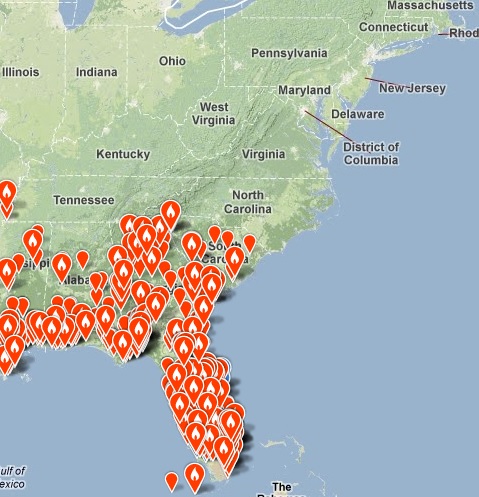
The Purple Martins have begun to move as well with early birds being reported throughout South Carolina this February. Take a look at the image below from an eBird map to see where they have been so far in 2013 with all of the orange pointers representing a sighting within the past 30 days.


Most of the earliest-returning individuals will arrive in Connecticut in the first week or two of April depending upon weather conditions. They are extremely vulnerable to cold and wet conditions in the early season as it naturally reduces the availability of their prey and can be fatal. As of now it seems that March is going to begin a little cooler than usual with a lot of chances for precipitation. Maybe we will undergo the unfortunately increasingly frequent rapid warm-up without much of a spring season again as you will remember the middle of last March featured temperatures in the 70s and 80s. If that is the case then we can be ready for more record-setting first-of-year arrivals as passerines will be rocketed in our direction on strong southerly flows.


Scott Kruitbosch
Conservation Technician