Tuesday's second big western rarity was a Mountain Bluebird. This one was discovered by Rollin Tebbetts at Bradley International Airport in Windsor Locks. Rollin is a birder who works at the airport, and therefore has access to areas the public does not. Nick Bonomo received photos from Rollin that he posted on his blog here: http://www.shorebirder.com/2010/12/mountain-bluebird-photos-from-rollin.html
The Mountain Bluebird has been viewable to a limited degree along Perimeter Road, though the public is only allowed to drive down this street due to the fact it runs along the perimeter of the airport - not to park, stop, or get out of their vehicle. The state police typically responds quickly to anyone who does. This has made the bird essentially a lost cause to anyone who wants to chase it. I do not advise going to see it...well, at least until this afternoon and some good news.
Thanks to Rollin and cooperation from the airport as well as the police, viewing will be allowed from Perimeter Road on Saturday morning, December 11, from 8AM until noon. That is your chance to get a look! If you want to see it and be able to do more than simply drive by you have to go then. There is a decent chance others will be located in the northeast in the next month or so. Past sightings of one bird have usually lead to more being found.
And it seems yet another western rarity was revealed today...

Friday, December 10, 2010


Thursday, December 9, 2010
Black-throated Gray Warbler
The Connecticut hits continued on Tuesday! The state has been unstoppable when it comes to very rare birds since the White-tailed Kite showed up on August 1. The first bird was a Black-throated Gray Warbler, endemic to the west coast from just into British Columbia through California and east to Colorado during the breeding season. It is seen in points south through Mexico in migration where it winters, though some may be able to be found in southern California. Past Connecticut records have come from the late fall and early winter, too. Frank Mantlik discovered this little gem in Westport while he was delivering mail. As Twan said, he is a rare bird magnet.
I know Frank has an extensive species list seen while working, with some very rare birds, but he did say this was probably the rarest passerine he has ever had on the job. He observed it foraging for insects in the small plantings of a house in a neighborhood right near Compo Beach. It was flitting around between yards and flying back and forth across the street. It stayed near the ground, and Frank was somehow able to grab his point and shoot and snap these quick photos of it:


Subsequent relocation searches that afternoon were unsuccessful. I was among a few people who searched the area Wednesday morning, but no one saw the little warbler again. After seeing the neighborhood I was even more impressed that Frank found it, and even more skeptical that it would be found. It was not exactly a great habitat for the species among lawns and small plantings. I believe it would feel much more at home near a sizable stand of trees. You just never know what you will find in Connecticut this year. We will soon see what the Christmas Bird Counts turn up - maybe the same species as Tuesday's second big rarity...
Photos © Frank Mantlik
I know Frank has an extensive species list seen while working, with some very rare birds, but he did say this was probably the rarest passerine he has ever had on the job. He observed it foraging for insects in the small plantings of a house in a neighborhood right near Compo Beach. It was flitting around between yards and flying back and forth across the street. It stayed near the ground, and Frank was somehow able to grab his point and shoot and snap these quick photos of it:


Subsequent relocation searches that afternoon were unsuccessful. I was among a few people who searched the area Wednesday morning, but no one saw the little warbler again. After seeing the neighborhood I was even more impressed that Frank found it, and even more skeptical that it would be found. It was not exactly a great habitat for the species among lawns and small plantings. I believe it would feel much more at home near a sizable stand of trees. You just never know what you will find in Connecticut this year. We will soon see what the Christmas Bird Counts turn up - maybe the same species as Tuesday's second big rarity...
Photos © Frank Mantlik
Wednesday, December 8, 2010
December events
As always I want to remind everyone to keep track of Connecticut Audubon Society events on our calendar page. You will find a diverse list to choose from, for children and adults, all across the state. Many are also free of charge. Here is a list of what is going on during the upcoming week.
Thu - Dec 09
4:00 PM - 4:30 PM Center at Fairfield: Creature Feature
Join us for a live animal program featuring our resident education animals. Get close up with mammals, reptiles, birds, amphibians and a few creepy crawlies. Our staff Naturalist and Animal Care volunteers will share facts and stories. Admission is by donation. Donations of laundry or dishwashing soap are greatly appreciated. For info call 203 259 6305, x 109.
Sat - Dec 11
Pomfret: Holiday Nature Store Opens November 27 through December 22
Featuring all kinds of gifts for all ages with Mother Nature in mind...bird feeders, houses and seed, gardening gifts, nature books, field guides, Christmas plants, nature jewelry, gift baskets, holiday swags and more. Tax Free Day on Opening Day...Saturday, November 27! Hours: Monday thru Friday, 9am-4pm; Saturday and Sunday, noon-4pm.
Sat - Dec 11
10:30 AM - 12:35 PM Center at Fairfield: Designing with Nature
Using natural metals, create a wreath or centerpiece that brings nature to your home. We'll provide materials and ideas to get you started. Members: $12/person. Non-members: $16/person. For info call 203 259 6305, x 109.
Sat - Dec 11
3:15 PM Seaside Stories at Milford Coastal Center
Get nice and cozy in our Milford Coastal Center and listen to a good tale about turtles. We'll make a craft and maybe the animals will come visit too!
Sun - Dec 12
2:00 PM Trailwood: 2nd Sunday Afternoon Walks
Join caretaker Vern Purlsley and walk the trails, read excerpts from Edwin Way Teale's books while slowing down and enjoying the quiet that is Trail Wood. Free...although donations are always appreciated.
Mon - Dec 13
9:30 AM - 10:15 AM Center at Fairfield Presents Nature Nursery: Colorful Winter
For 2-4 year olds accompanied by adult. Discover the different colors in a winter landscape from birds and animals to trees and plants. Introduce your little one to the sights, smells, sounds and feel of nature!
Wed - Dec 15
10:00 AM - 10:45 AM Nature Nursery: Colorful Winter at Birdcraft Museum
For 2-4 year olds accompanied by participating adult. Join us each week for a different colorful adventure with birds, animals, trees and plants.
Wed - Dec 15
12:00 PM Pomfret: Wednesday Lunch Walks
Get out of the house or office to stretch your legs and clear your head. Join CAS staff for some fresh air and exercise. Seniors and parents with babes in backpacks welcome. Free. Schedule, Wednesdays, Sept. 8 through Dec. 29.
Monday, December 6, 2010
eBird Occurrence Maps
I was planning to post something else about eBird tonight. That entry will have to wait. Earlier this afternoon I noticed the eBird team had posted the long-awaited first large set of occurrence maps on the site. Working from 42 million records and counting, the eBird team at the Cornell Lab has produced animated maps for each bird species that display their occurrence on a continental level throughout the year. This provides us with an easy to understand idea of the bird movement across the lower 48 states. Ten species were posted today, with five more to come each week. They can be found on this page along with the following detailed description of these powerful tools...
These maps, which are called STEM (Spatio-Temporal Exploratory Model) maps, use eBird checklists that report all species and include effort. The location of each checklist is associated with remotely-sensed information on habitat, climate, human population, and demographics. Fine-scale patterns of species occurrence relative to these variables (over 1000) are generated both regionally and temporally, to produce predicted occurrence at some 30,000 locations for every day of a single year (2008 in this case). This massive volume of information is then summarized on maps, which in many cases provide unprecedented information about the annual cycles of North American birds. These maps showcase the power of eBird – year-round, continental-scale monitoring of all species.
I definitely encourage you to visit the page and look at the maps. Each one really does tell a unique story and offer us something to learn. It goes without saying that all of this is possible because so many thousands of people use eBird every day. If you are not you need to be as soon as possible! You will not regret it, and there is no better time than the present. Even if you are recording data in another way, I hope you realize how eBird needs your sightings right now, past, present, and future, for amazing projects such as this one.
These maps, which are called STEM (Spatio-Temporal Exploratory Model) maps, use eBird checklists that report all species and include effort. The location of each checklist is associated with remotely-sensed information on habitat, climate, human population, and demographics. Fine-scale patterns of species occurrence relative to these variables (over 1000) are generated both regionally and temporally, to produce predicted occurrence at some 30,000 locations for every day of a single year (2008 in this case). This massive volume of information is then summarized on maps, which in many cases provide unprecedented information about the annual cycles of North American birds. These maps showcase the power of eBird – year-round, continental-scale monitoring of all species.
I definitely encourage you to visit the page and look at the maps. Each one really does tell a unique story and offer us something to learn. It goes without saying that all of this is possible because so many thousands of people use eBird every day. If you are not you need to be as soon as possible! You will not regret it, and there is no better time than the present. Even if you are recording data in another way, I hope you realize how eBird needs your sightings right now, past, present, and future, for amazing projects such as this one.
Saturday, December 4, 2010
Barnacle Goose update
At around 9AM today I re-found the rare Barnacle Goose that Frank Mantlik had discovered yesterday at Wooster Park in Stratford. I was unaware that he had seen it fly out of the pond there about 20 minutes earlier until I called and told him the news. I found it on the baseball field behind Bunnell High School with approximately 140 Canada Geese. Yesterday, when it was at Wooster Park, we observed it in the water, moving only a bit while preening and resting. Today I found it laying down on the grass feeding. Other geese were doing the same. However, when it got up very briefly, I noticed it had a left leg injury. It hobbled along for a few seconds before lying back down. After doing this again, I thought I saw bands on its legs as well.
 Barnacle Goose in the center (top bird) resting
As I was about to leave Frank arrived to see it. While discussing the goose we noticed it getting up and moving around a bit more. He immediately saw what I thought I had - bands on both legs. They looked quite obviously to be wild bands, and not of a domestic bird. Naturally, the injury and band placement was not in our favor. The right leg had a plain plastic white band over a silver band with characters that were too small to read (and are meant for the hand). The left leg had a white band with black characters on it that is meant to be read while at a distance in the field. As you can see from the photos and video the geese were relatively far from us as we were on top of a hill being pushed around by strong winds. Nevertheless, Frank's eagle eyes were able to scope two of three characters - the letters V and U followed by something else.
Here's the Barnacle hopping around holding up the injured leg as well as lying down feeding - this video was not meant to be pretty given the conditions, merely a record of a rare bird and a unique individual.
I was amazed Frank was able to read those two characters considering everything. The Barnacle often put its injured leg up and blocked our view as it hopped around. Canada Geese kept getting in between us, too. We both left a short time later figuring that would be sufficient for us to get somewhere, especially since I had a vague idea of reading about a banded Barnacle that had been seen recently in the northeast. We also stood a good chance of finding it there or somewhere else again later today or tomorrow.
 Barnacle Goose in the center feeding while lying down
Fortunately that was all we ended up needing. After Frank emailed the CT birding list what we had seen Deb Kral pointed him to this page that details how this very goose was seen at Orchard Beach in New York on November 26 and 27. It has the same first two band letters and the same leg injury. They were able to get even better views of the bands, tracing the bird as having been banded as a juvenile on November 13, 2002 - in Scotland! You can read more about this now eight year-old bird on this blog including the fact it was seen until March 2005 and its whereabouts were unknown until now. It is truly a fascinating find. We will monitor it as best as we can.
Photos and video © Scott Kruitbosch
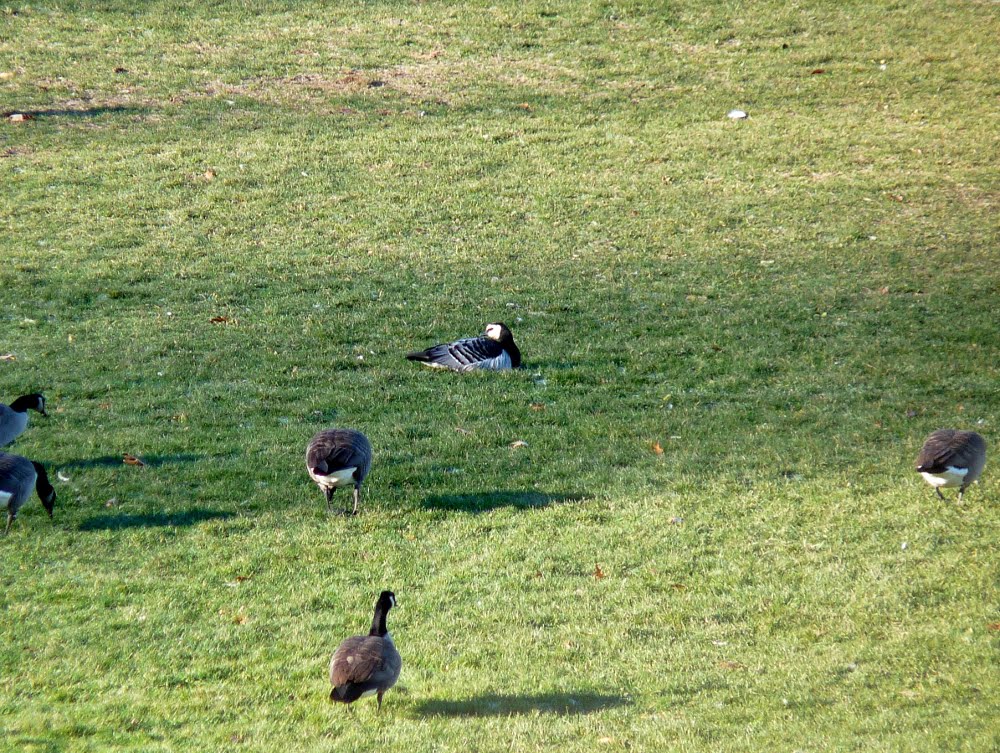 Barnacle Goose in the center (top bird) resting
As I was about to leave Frank arrived to see it. While discussing the goose we noticed it getting up and moving around a bit more. He immediately saw what I thought I had - bands on both legs. They looked quite obviously to be wild bands, and not of a domestic bird. Naturally, the injury and band placement was not in our favor. The right leg had a plain plastic white band over a silver band with characters that were too small to read (and are meant for the hand). The left leg had a white band with black characters on it that is meant to be read while at a distance in the field. As you can see from the photos and video the geese were relatively far from us as we were on top of a hill being pushed around by strong winds. Nevertheless, Frank's eagle eyes were able to scope two of three characters - the letters V and U followed by something else.
Here's the Barnacle hopping around holding up the injured leg as well as lying down feeding - this video was not meant to be pretty given the conditions, merely a record of a rare bird and a unique individual.
Remember you can make it full-screen by clicking the lower right button in the video or go to the link above to watch it in a larger size on the Vimeo website.
I was amazed Frank was able to read those two characters considering everything. The Barnacle often put its injured leg up and blocked our view as it hopped around. Canada Geese kept getting in between us, too. We both left a short time later figuring that would be sufficient for us to get somewhere, especially since I had a vague idea of reading about a banded Barnacle that had been seen recently in the northeast. We also stood a good chance of finding it there or somewhere else again later today or tomorrow.
 Barnacle Goose in the center feeding while lying down
Fortunately that was all we ended up needing. After Frank emailed the CT birding list what we had seen Deb Kral pointed him to this page that details how this very goose was seen at Orchard Beach in New York on November 26 and 27. It has the same first two band letters and the same leg injury. They were able to get even better views of the bands, tracing the bird as having been banded as a juvenile on November 13, 2002 - in Scotland! You can read more about this now eight year-old bird on this blog including the fact it was seen until March 2005 and its whereabouts were unknown until now. It is truly a fascinating find. We will monitor it as best as we can.
Photos and video © Scott Kruitbosch
Friday, December 3, 2010
Barnacle Goose Stratford
This has been a big year for the Barnacle Goose in Connecticut and the northeast as a whole. Europe has been seeing some very rough weather that may be to blame for it, as well as two Northern Lapwing sightings including Connecticut's first record. As someone who follows the weather, I have been watching it for some time as they get the snow and cold that I keep hoping for. Frank Mantlik found a Barnacle Goose at Wooster Park in Stratford earlier this morning. I popped over there shortly after he discovered it. Frank told me it was with a group of Canada that flew off, though fortunately it stayed for myself and others to stop by. You can see the goose resting and preening amongst the hundreds of Mallards, some Green-winged Teal, and a couple of American Black Duck in the HD video below.
The fact it is resting and preening was likely why it stayed when the other geese left. Frank also saw a Mallard and Northern Pintail hybrid he has found here in previous years. It is quite a nice looking duck. Once again, the temperatures have plummeted here. Ponds and lakes to the north should be freezing up soon. A couple days ago, I tweeted on the CAS Twitter account about how, before the warm front, this was already helping move waterfowl in to Connecticut. There is a lot more to come very soon as the state stays cold yet dry in the near future. The only storm threat in the next week seems to be a tiny threat from a system that retrogrades near the gulf of Maine. Flurries seem to be the only chance of precipitation, but it could move more interesting birds in and around the area.
Video © Scott Kruitbosch
The fact it is resting and preening was likely why it stayed when the other geese left. Frank also saw a Mallard and Northern Pintail hybrid he has found here in previous years. It is quite a nice looking duck. Once again, the temperatures have plummeted here. Ponds and lakes to the north should be freezing up soon. A couple days ago, I tweeted on the CAS Twitter account about how, before the warm front, this was already helping move waterfowl in to Connecticut. There is a lot more to come very soon as the state stays cold yet dry in the near future. The only storm threat in the next week seems to be a tiny threat from a system that retrogrades near the gulf of Maine. Flurries seem to be the only chance of precipitation, but it could move more interesting birds in and around the area.
Video © Scott Kruitbosch
Thursday, December 2, 2010
NASA-funded research changes biology forever
An announcement by NASA earlier this afternoon changed biology, our understanding of the Earth, and our knowledge of the universe forever. A microorganism was discovered in California that reproduces and thrives off arsenic, even using it for cell components. This is a new building block of life. Suffice it to say, I think the article from NASA that I have linked to and put below is worth a close read. Once again we have been shown that the facts humanity "knows" to be true will likely be bent, broken, and dismissed repeatedly as we make technological advances and continue to explore the universe. It is fascinating in itself that this time the astonishing find was in our backyard.
==================================================================
NASA-Funded Research Discovers Life Built With Toxic Chemical
NASA-funded astrobiology research has changed the fundamental knowledge about what comprises all known life on Earth.
Researchers conducting tests in the harsh environment of Mono Lake in California have discovered the first known microorganism on Earth able to thrive and reproduce using the toxic chemical arsenic. The microorganism substitutes arsenic for phosphorus in its cell components.
"The definition of life has just expanded," said Ed Weiler, NASA's associate administrator for the Science Mission Directorate at the agency's Headquarters in Washington. "As we pursue our efforts to seek signs of life in the solar system, we have to think more broadly, more diversely and consider life as we do not know it."
This finding of an alternative biochemistry makeup will alter biology textbooks and expand the scope of the search for life beyond Earth. The research is published in this week's edition of Science Express.
Carbon, hydrogen, nitrogen, oxygen, phosphorus and sulfur are the six basic building blocks of all known forms of life on Earth. Phosphorus is part of the chemical backbone of DNA and RNA, the structures that carry genetic instructions for life, and is considered an essential element for all living cells.
Phosphorus is a central component of the energy-carrying molecule in all cells (adenosine triphosphate) and also the phospholipids that form all cell membranes. Arsenic, which is chemically similar to phosphorus, is poisonous for most life on Earth. Arsenic disrupts metabolic pathways because chemically it behaves similarly to phosphate.
"We know that some microbes can breathe arsenic, but what we've found is a microbe doing something new -- building parts of itself out of arsenic," said Felisa Wolfe-Simon, a NASA Astrobiology Research Fellow in residence at the U.S. Geological Survey in Menlo Park, Calif., and the research team's lead scientist. "If something here on Earth can do something so unexpected, what else can life do that we haven't seen yet?"
The newly discovered microbe, strain GFAJ-1, is a member of a common group of bacteria, the Gammaproteobacteria. In the laboratory, the researchers successfully grew microbes from the lake on a diet that was very lean on phosphorus, but included generous helpings of arsenic. When researchers removed the phosphorus and replaced it with arsenic the microbes continued to grow. Subsequent analyses indicated that the arsenic was being used to produce the building blocks of new GFAJ-1 cells.
The key issue the researchers investigated was when the microbe was grown on arsenic did the arsenic actually became incorporated into the organisms' vital biochemical machinery, such as DNA, proteins and the cell membranes. A variety of sophisticated laboratory techniques was used to determine where the arsenic was incorporated.
The team chose to explore Mono Lake because of its unusual chemistry, especially its high salinity, high alkalinity, and high levels of arsenic. This chemistry is in part a result of Mono Lake's isolation from its sources of fresh water for 50 years.
The results of this study will inform ongoing research in many areas, including the study of Earth's evolution, organic chemistry, biogeochemical cycles, disease mitigation and Earth system research. These findings also will open up new frontiers in microbiology and other areas of research.
"The idea of alternative biochemistries for life is common in science fiction," said Carl Pilcher, director of the NASA Astrobiology Institute at the agency's Ames Research Center in Moffett Field, Calif. "Until now a life form using arsenic as a building block was only theoretical, but now we know such life exists in Mono Lake."
The research team included scientists from the U.S. Geological Survey, Arizona State University in Tempe, Ariz., Lawrence Livermore National Laboratory in Livermore, Calif., Duquesne University in Pittsburgh, Penn., and the Stanford Synchroton Radiation Lightsource in Menlo Park, Calif.
NASA's Astrobiology Program in Washington contributed funding for the research through its Exobiology and Evolutionary Biology program and the NASA Astrobiology Institute. NASA's Astrobiology Program supports research into the origin, evolution, distribution, and future of life on Earth.
For more information about the finding and a complete list of researchers, visit:
http://astrobiology.nasa.gov
==================================================================
NASA-Funded Research Discovers Life Built With Toxic Chemical
NASA-funded astrobiology research has changed the fundamental knowledge about what comprises all known life on Earth.
Researchers conducting tests in the harsh environment of Mono Lake in California have discovered the first known microorganism on Earth able to thrive and reproduce using the toxic chemical arsenic. The microorganism substitutes arsenic for phosphorus in its cell components.
"The definition of life has just expanded," said Ed Weiler, NASA's associate administrator for the Science Mission Directorate at the agency's Headquarters in Washington. "As we pursue our efforts to seek signs of life in the solar system, we have to think more broadly, more diversely and consider life as we do not know it."
This finding of an alternative biochemistry makeup will alter biology textbooks and expand the scope of the search for life beyond Earth. The research is published in this week's edition of Science Express.
Carbon, hydrogen, nitrogen, oxygen, phosphorus and sulfur are the six basic building blocks of all known forms of life on Earth. Phosphorus is part of the chemical backbone of DNA and RNA, the structures that carry genetic instructions for life, and is considered an essential element for all living cells.
Phosphorus is a central component of the energy-carrying molecule in all cells (adenosine triphosphate) and also the phospholipids that form all cell membranes. Arsenic, which is chemically similar to phosphorus, is poisonous for most life on Earth. Arsenic disrupts metabolic pathways because chemically it behaves similarly to phosphate.
"We know that some microbes can breathe arsenic, but what we've found is a microbe doing something new -- building parts of itself out of arsenic," said Felisa Wolfe-Simon, a NASA Astrobiology Research Fellow in residence at the U.S. Geological Survey in Menlo Park, Calif., and the research team's lead scientist. "If something here on Earth can do something so unexpected, what else can life do that we haven't seen yet?"
The newly discovered microbe, strain GFAJ-1, is a member of a common group of bacteria, the Gammaproteobacteria. In the laboratory, the researchers successfully grew microbes from the lake on a diet that was very lean on phosphorus, but included generous helpings of arsenic. When researchers removed the phosphorus and replaced it with arsenic the microbes continued to grow. Subsequent analyses indicated that the arsenic was being used to produce the building blocks of new GFAJ-1 cells.
The key issue the researchers investigated was when the microbe was grown on arsenic did the arsenic actually became incorporated into the organisms' vital biochemical machinery, such as DNA, proteins and the cell membranes. A variety of sophisticated laboratory techniques was used to determine where the arsenic was incorporated.
The team chose to explore Mono Lake because of its unusual chemistry, especially its high salinity, high alkalinity, and high levels of arsenic. This chemistry is in part a result of Mono Lake's isolation from its sources of fresh water for 50 years.
The results of this study will inform ongoing research in many areas, including the study of Earth's evolution, organic chemistry, biogeochemical cycles, disease mitigation and Earth system research. These findings also will open up new frontiers in microbiology and other areas of research.
"The idea of alternative biochemistries for life is common in science fiction," said Carl Pilcher, director of the NASA Astrobiology Institute at the agency's Ames Research Center in Moffett Field, Calif. "Until now a life form using arsenic as a building block was only theoretical, but now we know such life exists in Mono Lake."
The research team included scientists from the U.S. Geological Survey, Arizona State University in Tempe, Ariz., Lawrence Livermore National Laboratory in Livermore, Calif., Duquesne University in Pittsburgh, Penn., and the Stanford Synchroton Radiation Lightsource in Menlo Park, Calif.
NASA's Astrobiology Program in Washington contributed funding for the research through its Exobiology and Evolutionary Biology program and the NASA Astrobiology Institute. NASA's Astrobiology Program supports research into the origin, evolution, distribution, and future of life on Earth.
For more information about the finding and a complete list of researchers, visit:
http://astrobiology.nasa.gov
Subscribe to:
Posts (Atom)