Here is a rundown of upcoming events at three Connecticut Audubon Society locations: the Birdcraft Museum and Sanctuary and the CAS Center in Fairfield, as well as the Coastal Center at Milford Point. You can find more details and contact information on each center's page, linked above.
First, Birdcraft...
Nature Nursery, Wednesdays, 10-10:45 a.m. on Oct. 13, 20, 27, Nov. 3, 10, 17. -- Ready, Set, Sleep! Who's staying up all winter, who's getting ready to sleep and who's going somewhere else? Discover how nature prepares for winter. For 2-3 year olds accompanied by an actively participating adult. Advance registration required. Program fee (1 child & 1 adult): $12 CAS Members, $16 Non-members. 6-program fee: $66 CAS Members, $90 Non-members.
Bird Banding Demonstrations, Wednesdays, Sept. 15, 22, 7:30-8:30 a.m. -- Our bird banding station's research shows that on average 120+ different species visit our 6-acre Birdcraft Sanctuary as a resting and refueling stop along their migratory route. Discover which birds are stopping over this fall. Advance registration required. Single program fee: $7/person (family max. $21) CAS members, $12/person (family max. $36) Non-members. In case of inclement weather, program is postponed to Thursday.
At the Fairfield center...
Nature Nursery, Mondays, 9:30-10:15 a.m. on Oct. 18, 25, Nov. 1, 8, 15, 22. -- Fall in the Forest" series is for 2-4 year olds accompanied by an adult, We'll explore the changes in our Larsen Wildlife Sanctuary during the fall. Each program includes an outdoor exploration, stories and craft. Advance registration required. Program fee (1 adult & 1 child): $12 CAS Members; $16 Non-members. 6-program series: $66 CAS Members; $90 Non-members.
Science Sleuths & Nature Nuts on Saturdays, 10:30 a.m.-noon on Oct. 16, 23, 30 and Nov. 6, 13, 20. -- Ornithology. Entomology. Ecology. Zoology. Join our teacher-naturalists for this great introduction to the different areas of scientific study. We'll explore Larsen Wildlife Sanctuary from the point of view of a different "-ologist" each week. For children in grades 3-5. Advance registration required. Program fee: $12 CAS Members, $16 Non-members. 6-program series: $66 CAS Members, $90 Non-members.
Family Campfire and Goodnight Walk on Fri., Sept. 24, 6:30--8 p.m. -- Join us for an evening around a campfire with stories and s'mores. We'll take a short walk to experience the sights and sounds of our Larsen Wildlife Sanctuary. Suitable for all ages. Advance registration required. Fee: $7/person (family max. $21) CAS members, $12/person (family max. $36) Non-members.
Finally, at Milford Point...
Guided Family Canoe Tours, Sat., Sept. 11, 12:30-3 p.m.; Sun., Sept. 12, 1:30-4 p.m.; or Sat., Sept. 25, 11:30 a.m.-2 p.m. -- Take one of our tours and explore the 840-acre Wheeler Salt Marsh. CAS naturalists will describe the area's long history and point out the Marsh's many bird species and other wildlife, while you enjoy the beautiful vistas and paddle and relax. Advance registration required. Fees using our canoes for CAS Members: $25/person, $65/canoe (up to 3 people). For Non-members: $35/person, $95/canoe. Fees using your own canoe or kayak: $19 CAS Members, $29 Non-members.
"Sea Squirts" programs on Thursdays, 10:30-11:30 a.m., are for 3-5 years olds accompanied by an adult. They begin Sept. 9 with "Hoot for Owls!"; Sept. 23, "Going Batty at the Beach!"; Oct. 7, "Falling Leaves"; Oct. 21, "Migrating Monarchs"; Nov. 4, "Wonderful Webs"; Nov. 18, "Traveling Seeds"; and Dec. 2, "Animals in Winter." Each features an outdoor discovery walk or live-animal presentation, stories, songs and crafts. Advance registration required. Single program fee (1 child & 1 adult): $10 CAS Members, $15 Non-members; add $5 for each additional child.
Charles Island Explorations on Wed., Sept. 8, 5 p.m.; Sun., Sept. 12, 8 a.m.; Thurs., Sept. 23, 5 p.m.; and Tues., Oct. 12, 8:30 a.m. Discover the natural history and folklore that make this special place the "treasure" of Milford. Advance registration only. Daily fee: $10/adult, $6/child CAS Members; $15/adult; $10/child Non-Members; $5/seniors.

Saturday, September 4, 2010


Thursday, September 2, 2010
White-tailed Kite month #2 and early Earl pics
The White-tailed Kite has entered its second month at Stratford Point. It is beyond amazing. I do not know of anyone that thought this length of a stay probable or even considered it a possibility. Some people thought it would depart instantly, while others pointed to the molt and said it would have to stay for some time...as long as it ate well. Yet here we are. It does need to replace some tail feathers, as you can see in the great photos below, so perhaps that will keep it around some more.


Thanks to Paul Fusco and Scott Vincent for those pictures. The past week was very tough, with record-setting hot and humid weather yet again. It was not a conducive week to depart on a long journey. When you consider the fact the White-tailed Kite will be leaving in a general direction, not knowing where to stop on the way for any source of acceptable habitat for feeding, you have to think it will leave when it is in perfect shape in optimal weather conditions. This will probably include a sunny, clear day that can build thermals (rising warm air that raptors utilize in migration), moderate temperatures, perfect visibility, and a heck of a tail wind from the north. We will have a couple days exactly like this one coming up soon. The next week will feature two cold fronts, the first in the wake of hurricane Earl.
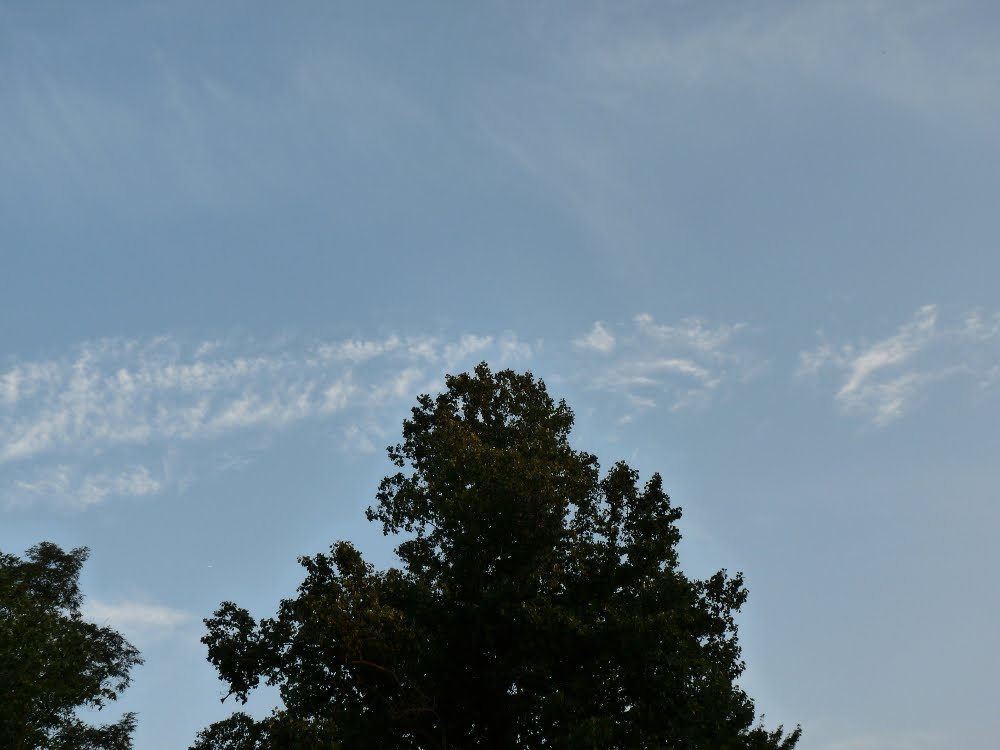
I have not posted on Earl because, well, any discussion on a tropical cyclone can easily get out of hand and out of date. It is not particularly suited to the blog format. Suffice it to say we were spared a big hit once again in New England, and it seems on nearly the entire east coast. I took these photos of hurricane Earl on Thursday evening around 7PM from Stratford!


That is less than exciting, huh? Well, I was not lying - it is Earl. Those are cirrus clouds from Earl's outflow, the air flowing out from the storms embedded in the hurricane. No one would ever know they were the first "signs" of a hurricane if they looked at those pictures without being told. It is not exactly a flashing billboard. Thankfully, none of us needs that billboard, as the effects should be minimal and at worst comparable to the routine storm system we had early last week. We will see if it is strong enough to bring in rare birds from the sea or the south. Can Stratford Point score another big name species?
Photo 1 © Paul Fusco; photos 2-3 © Scott Vincent; photos 4-5 © Scott Kruitbosch


Thanks to Paul Fusco and Scott Vincent for those pictures. The past week was very tough, with record-setting hot and humid weather yet again. It was not a conducive week to depart on a long journey. When you consider the fact the White-tailed Kite will be leaving in a general direction, not knowing where to stop on the way for any source of acceptable habitat for feeding, you have to think it will leave when it is in perfect shape in optimal weather conditions. This will probably include a sunny, clear day that can build thermals (rising warm air that raptors utilize in migration), moderate temperatures, perfect visibility, and a heck of a tail wind from the north. We will have a couple days exactly like this one coming up soon. The next week will feature two cold fronts, the first in the wake of hurricane Earl.
I have not posted on Earl because, well, any discussion on a tropical cyclone can easily get out of hand and out of date. It is not particularly suited to the blog format. Suffice it to say we were spared a big hit once again in New England, and it seems on nearly the entire east coast. I took these photos of hurricane Earl on Thursday evening around 7PM from Stratford!

That is less than exciting, huh? Well, I was not lying - it is Earl. Those are cirrus clouds from Earl's outflow, the air flowing out from the storms embedded in the hurricane. No one would ever know they were the first "signs" of a hurricane if they looked at those pictures without being told. It is not exactly a flashing billboard. Thankfully, none of us needs that billboard, as the effects should be minimal and at worst comparable to the routine storm system we had early last week. We will see if it is strong enough to bring in rare birds from the sea or the south. Can Stratford Point score another big name species?
Photo 1 © Paul Fusco; photos 2-3 © Scott Vincent; photos 4-5 © Scott Kruitbosch
Monday, August 30, 2010
Gulls hawking insects
While waiting for a possible return for a second feeding of the night by the White-tailed Kite yesterday Stratford Point visitors were treated to another entertaining sight in the form of gulls catching bugs. The phenomenon is not new to me, but it is to many people who do not live in coastal areas, or frequent certain spots when it often occurs in the late summer or early fall. Essentially hundreds or even thousands of gulls took to the air like swallows to devour insects flying over our heads at Stratford Point and Short Beach. At first, I thought something had spooked up a group at Short Beach - maybe someone feeding them or a raptor - until they stayed in the air. It was obvious feeding time was on as they ascended at Stratford Point as well.
We could see the seemingly limitless insects in the air against the sunlight. Plenty of sand flies and other nasty bugs were biting us as well. The gulls were primarily Ring-billed, though a fair number of Laughing Gulls and some Herring Gulls also participated. This went on for over an hour and lead to some great photographic possibilities, which you can see below. Thank you to our friends Townsend P. Dickinson and Scott A. Vincent! I do not know what the insects were. If anyone has a definitive answer please comment on it for us. The last photo is your prototypical bug catcher, Barn Swallows. We had many there today in place of the gulls.
And that White-tailed Kite of ours? As of tonight it is still here...


Photos 1-5 © Townsend P. Dickinson; photos 6-8 © Scott A. Vincent
Sunday, August 29, 2010
White-tailed Kite Video 4
The White-tailed Kite continues for the 29th day. Since I put up more photos yesterday I figured why not a fourth video today! This is the longest so far, nearly 2 minutes shot from August 17 through August 28. It features, almost in order, the kite diving, interacting with gulls and terns, hovering, scratching itself in mid-air, sitting on the beach, and ends with it perched on a tree snag. All but the last parts of it sitting on the snag are from Stratford Point, with that being from Short Beach in Stratford.
Video © Scott Kruitbosch
White-tailed Kite 4 from Connecticut Audubon Society.
Video © Scott Kruitbosch
White-tailed Kite pictures
Here are some White-tailed Kite photos...because, well, it's a White-tailed Kite in Connecticut. Even though this is the beginning of day 29 it is still staggering to think of this bird even being within 500 miles of New England. The first two are from me while the other three are from, once again, Scott Vincent - thanks! Mine were shot on August 28, one in the morning on the beach at Stratford Point and the other on a snag in the evening at Short Beach. Mr. Vincent's are from the evening of August 27 at Stratford Point.


Photos 1-2 © Scott Kruitbosch; photos 3-5 © Scott Vincent


Photos 1-2 © Scott Kruitbosch; photos 3-5 © Scott Vincent
Friday, August 27, 2010
White-tailed Kite Day 27
The White-tailed Kite has a secret I have slowly let out the last few days. It is, without a doubt, spending much more time at Stratford Point. This is because it is feeding more than it did for the first 20-25 days. The kite never had more than one meal at night, but it has had multiple kills in the late afternoon evening in the past four days. The mere fact it is actually at Stratford Point at, say, 11AM or 4PM is out of character. It is eating nearly as much as it can, still hunting with a full crop.
On Thursday night, August 26, we had an interesting event. After the kite hunted for a long time, putting on quite a show for everyone, it took a vole to eat on the beach. This in itself was a bit strange, though not unheard of - it has fed on the seawall at times lately. After it landed, I noticed a Great Black-backed Gull land near it. The gull went right up to the kite, circling it, pacing around waiting for a chance to take the vole. The weight class was not even close as the kite looked tiny compared to the massive gull. The raptor bobbed its tail repeatedly and mantled the prey. It was able to intimidate the gull just enough, eating the vole slowly. Once it took off the gull chased it closely for another minute.
 A poor distant shot of the action as we watched it, White-tailed Kite on the left and Great Black-backed Gull on the right.
But what's the biggest news? Around 4 this afternoon the kite snatched and ate a vole. It sat in a tree at Stratford Point, occasionally flying around the property, thinking about another meal. Around 5:30, the kite took off, flying high near west side of the property. It used a thermal to climb hundreds of feet into the air...and then thousands. It passed an Osprey on the way up, becoming invisible to the naked eye in the sky and barely in binocular view even though it was directly over Stratford Point. When it turned and headed south, I was literally saying "goodbye!" as the three of us there thought we were witnessing the departure. Conditions were very favorable with a northerly flow after yesterday's cold front. The only odd thing was that it was so late in the day. A minute later, it slowly came back to sea level, ending up in the same tree it sat in most of the day. It later hunted and then left around 7:30 in the usual way.
 Showing off the new feathers.
There seems to be no doubt the White-tailed Kite is preparing to leave. My best guess was that it would leave in September after a cold front (and after the molt was complete). The molt is nearly done, and nearly all the new feathers have come in. Outside of tomorrow, the next week will not be conducive to movement. We will have a warm and tropical-feeling southerly flow with winds going in the opposite direction it needs to go. This may keep it here. I have the feeling the kite is thinking about leaving tomorrow or in the next couple of days. What it does not know is that after tomorrow it is going to be tough. We'll see! Speaking of that, if you have not seen the kite, the time is clearly now.
Photos © Scott Kruitbosch
Thursday, August 26, 2010
25 days of Stratford Point
Here is a list of the species I have recorded at Stratford Point during the first 25 days of White-tailed Kite mania. This only includes official surveys completed by myself. It does not include some sighted outside that time by others such as the Wilson's Storm-Petrel seen a few days ago. The official tally is 88, but it is likely over 90 on the site as a whole. Did you visit and see something not listed? Please email it to me! We would love to hear about it. This goes for any "good" sighting you have there or at any of our sanctuaries or centers (PDF file).
1. Mute Swan
2. Green-winged Teal
3. Brown Pelican
4. Double-crested Cormorant
5. Great Blue Heron
6. Great Egret
7. Snowy Egret
8. Cattle Egret
9. Green Heron
10. Glossy Ibis
11. Turkey Vulture
12. Osprey
13. White-tailed Kite
14. Sharp-shinned Hawk
15. American Kestrel
16. Merlin
17. Peregrine Falcon
18. Black-bellied Plover
19. American Golden-Plover
20. Semipalmated Plover
21. Piping Plover
22. Killdeer
23. American Oystercatcher
24. Spotted Sandpiper
25. Greater Yellowlegs
26. Willet (and “western” subspecies)
27. Lesser Yellowlegs
28. Whimbrel
29. Ruddy Turnstone
30. Sanderling
31. Semipalmated Sandpiper
32. Least Sandpiper
33. Short-billed Dowitcher
34. Laughing Gull
35. Ring-billed Gull
36. Herring Gull
37. Great Black-backed Gull
38. Least Tern
39. Black Tern
40. Roseate Tern
41. Common Tern
42. Forster's Tern
43. Royal Tern
44. Black Skimmer
45. Rock Pigeon
46. Mourning Dove
47. Monk Parakeet
48. Chimney Swift
49. Ruby-throated Hummingbird
50. Downy Woodpecker
51. Northern Flicker
52. Yellow-bellied Flycatcher
53. Willow Flycatcher
54. Eastern Kingbird
55. Blue Jay
56. American Crow
57. Fish Crow
58. Northern Rough-winged Swallow
59. Purple Martin
60. Tree Swallow
61. Bank Swallow
62. Barn Swallow
63. Cliff Swallow
64. Tufted Titmouse
65. Red-breasted Nuthatch
66. Carolina Wren
67. House Wren
68. Blue-gray Gnatcatcher
69. American Robin
70. Gray Catbird
71. Northern Mockingbird
72. European Starling
73. Cedar Waxwing
74. Yellow Warbler
75. Prairie Warbler
76. Common Yellowthroat
77. Song Sparrow
78. Northern Cardinal
79. Indigo Bunting
80. Bobolink
81. Red-winged Blackbird
82. Common Grackle
83. Brown-headed Cowbird
84. Orchard Oriole
85. Baltimore Oriole
86. House Finch
87. American Goldfinch
88. House Sparrow
I would bet a couple more warblers were here, too. If someone had been there to see it fly by Stratford Point we could add a Caspian Tern from Milford Point seen a couple weeks ago. That is exactly why we have seen so much more, from the Brown Pelican to Cattle Egret to many other more common birds - more time and more eyes in the field. Caspian Tern is one we still missed. What else could have gone by without us knowing? I don't think I want to ponder question that too much...let's just hope it wasn't any better than a White-tailed Kite.
Subscribe to:
Posts (Atom)