Jumping ahead to Sunday, the second Boothe Park Hawk Watch of the Great Stratford Bird Festival went much better than the first. I realized when I started writing this entry I did not take any pictures during this event - and while I wish that was not the case, it demonstrates the busy day we had. Many visitors stopped by and experienced an abundant raptor flight.
A weak cold front moved through Connecticut the night before. The high pressure to the west was slow to move in before an overrunning pattern set up. We had no cold air mass behind this front, and with the first overrunning system already coming in, we had nearly 100% cloud cover for most of the day. The fact the high did not move in kept the winds essentially nonexistent with a weak northerly flow that turned northeast for most of the day. Northerly winds are nearly required for diurnal raptor movement of any substantial kind. Winds turned east at 4:30 with the low pressure coming in and the day was essentially over.
I started the count at 9AM, knowing Boothe Park probably had some passerine migrants from the night before. Our friend Charles Barnard Jr. came down to observe with me and answer any questions while telling some great stories. Visitors started coming by right at 11AM as the hawks really started taking flight. We had some wonderful observations before most people started departing. However, things only improved from there. Around 2, we had an adult Golden Eagle come in low over the rose garden. We even had a few minutes to observe it before it soared away. If that rare sight was not enough, at around 3:30 Charlie and I saw a juvenile Northern Goshawk fly right over our heads.
In the late afternoon what I called a "parade of Merlins" started. The falcon species was spotted, for the most part, flying over low on a north to south track. While we have only been recording hawks officially at Boothe Park for two seasons now, our old record of 5 was shattered as we saw 21 go by us. I observed one Merlin eating a dragonfly on the wing. Charlie spotted another that we thought had a bird in its talons.
The day ended up also being the best recorded yet for Cooper's Hawk and Peregrine Falcon. Below is the complete list from the Boothe Park count site for the day. It adds up to 49 species. The Turkey Vulture, 1 Peregrine Falcon, 2 Osprey, and 2 Red-tailed Hawk were "local" birds not migrating. All of the other raptors were migrants. That total ended up being 262 on the day with some very nice records and an impressively diverse flight.
3 American Black Duck
9 Double-crested Cormorant
1 Great Blue Heron
1 Turkey Vulture
37 Osprey
3 Bald Eagle
5 Northern Harrier
126 Sharp-shinned Hawk
43 Cooper's Hawk
1 Northern Goshawk
5 Broad-winged Hawk
3 Red-tailed Hawk
1 Golden Eagle
12 American Kestrel
21 Merlin
6 Peregrine Falcon
4 Ring-billed Gull
9 Herring Gull (American)
3 Rock Pigeon
1 Mourning Dove
18 Monk Parakeet
28 Chimney Swift
1 Ruby-throated Hummingbird
1 Red-bellied Woodpecker
1 Downy Woodpecker
2 Northern Flicker
1 Eastern Phoebe
47 Blue Jay
3 American Crow
1 Fish Crow
56 Tree Swallow
2 Black-capped Chickadee
1 Red-breasted Nuthatch
1 White-breasted Nuthatch
2 Golden-crowned Kinglet
2 American Robin
1 Gray Catbird
2 Northern Mockingbird
1 Brown Thrasher
650 European Starling
14 Cedar Waxwing
1 Chipping Sparrow
2 White-throated Sparrow
1 Northern Cardinal
130 Common Grackle
108 Brown-headed Cowbird
2 House Finch
3 American Goldfinch
30 House Sparrow
Thank you to everyone who came and helped us watch the skies. We hope to see you again soon. There are definitely some very large flight days yet to come this fall.

Wednesday, September 29, 2010


Tuesday, September 28, 2010
Great Stratford Bird Festival - Boothe Park Hawk Watch #1
I ran the Boothe Park Hawk Watch as an event for the Great Stratford Bird Festival from 11-2 on Saturday. A big crowd joined me the next day, but Sunday deserves its own entry. So far, in the fall of 2010 we, primarily I and expert birder Charles Barnard Jr., have put in 80.25 hours at the site. We have recorded 4,619 migrant raptors, 3,404 of which were Broad-winged Hawks. The site’s profile, with all of the data, is on the Hawk Migration Association of North America website and located here.

As I have written previously, Boothe Park is located at 5800 Main St. in the Putney section of Stratford. Our count site is between the award-winning rose garden and the historic clock tower, the latter being obvious in photo below. On Saturday, the conditions were horrible for migrating hawks, with gusty southwest winds in a very warm flow. I recorded a shockingly high temperature of 90 at noon with my very precise handheld anemometer.

Suffice it to say very little was flying. In the time I was there, I recorded a grand total of four raptors – one each of Osprey, Bald Eagle, Sharp-shinned Hawk, and American Kestrel. While these are always wonderful sights, spending hours in 90-degree sun only to see a brief distant glimpse of a raptor every 30 to 45 minutes is not exactly fulfilling. I am certainly biased because of some of my recent experiences, such as seeing 876 Broad-winged Hawks in one hour while I was alone at the site on September 20.

We are only at the site when we have a chance, and those moments are rare. Additionally, we often only count when continues are favorable. While this is a bit unscientific, we do not have the liberty of spending copious amounts of time there. I hope that in time we will have enough observers and time to be able to do so. Please feel free to visit and watch with us if you see us at the site. If you notice some strong northwest winds on a Saturday afternoon there is a good shot we will be there.
Photos © Twan Leenders
Monday, September 27, 2010
Great Stratford Bird Festival - Wings Over Wild and more
The Great Stratford Bird Festival continued after the Saturday morning bird banding with many more attractions. Several vendors set up at Stratford Point with everything from magnificent paintings, beautiful photography, birding equipment and books. The duck carving exhibits were opened to the public. The U.S. Fish and Wildlife Service had set up their traveling exhibit and were on hand to answer any questions the public had.

Soon after we had a very special visitor stop by. The photo below is the host of the 2010 Great Stratford Bird Festival, Phil Donahue, a long-time friend and supporter of Connecticut Audubon Society. Here he can be seen touring the vibrant scene at Stratford Point with Milan Bull, CAS Senior Director of Science and Conservation.

Wind Over Wings put on an amazing live raptor show later in the morning. I had already departed for the Boothe Park Hawk Watch, but CAS Conservation Biologist Dr. Twan Leenders was there to watch and photograph the event. He described it as "fantastic" and a "must see".


As you can see in one of the above photos, Wind Over Wings was given permission by the U.S. Fish and Wildlife Service to both posses and exhibit these birds. Both nocturnal and diurnal birds of prey were present.


They are moving their operation to Maine next summer, and will be doing a farewell tour of Connecticut starting next June. If you have not seen their presentation yet, try to catch one before they leave the state. Thanks to all of these wonderful guests for their contributions to the Great Stratford Bird Festival.
Photos © Twan Leenders
Sunday, September 26, 2010
Great Stratford Bird Festival - banding
One of the first events of the Great Stratford Bird Festival was bird banding at Stratford Point. Director of the CAS Coastal Center at Milford Point, Frank Gallo, opened the mist nets at 7AM to see what we could catch. He is an expert on not only the birds of Connecticut but banding as well. His expansive knowledge is unbelievable. Frank noted that the breezy morning with relatively few migrant passerines from the night before would likely mean we would catch very few birds, if any, in the nets. Don't worry about the birds though - Frank and my fellow blog author Twan are federally licensed bird banders who are specially trained and authorized to do this sort of scientific research. This is definitely a "don't try this at home" sort of thing.
 Hey, what do Frank and I have?
Luckily we were able to get some, and by 8:45 we had a Song Sparrow and a Swamp Sparrow. Both of them were in the one section of net spanning basically east to west. It would catch birds going, in effect, towards the mouth of the river or away from it.
 Frank holding the Song Sparrow
 A closer look at the Song Sparrow
After we extracted these birds from the net we went and checked all the nets, pulling out any plants or insects that had been caught. While doing this I spotted another Swamp Sparrow flying by and actually saw it fly into the same net that caught the others. We took this one back with the other two.
 CAS Conservation Biologist Dr. Twan Leenders getting a Swamp Sparrow
 And here is that Swamp Sparrow
Frank banded all three, completing everything from wing measurements to weighing them to checking their age. Here he is going through the motions with one of the Swamp Sparrows.

I learned a lot from Frank simply by watching and listening, and I know everyone would appreciate watching his talent in action sometime. We did not catch any other birds before closing the nets. However, we did leave them up for use in the Stratford Bioblitz at the very least. I have to imagine we could find some very interesting fall sparrows in them in October...
Over the next few days I will post more in depth accounts and photos of some Great Stratford Bird Festival events after a very successful weekend. Stay tuned.
Photos 1-2 © Twan Leenders; photos 3-6 © Scott Kruitbosch
 Hey, what do Frank and I have?
Luckily we were able to get some, and by 8:45 we had a Song Sparrow and a Swamp Sparrow. Both of them were in the one section of net spanning basically east to west. It would catch birds going, in effect, towards the mouth of the river or away from it.
 Frank holding the Song Sparrow
 A closer look at the Song Sparrow
 CAS Conservation Biologist Dr. Twan Leenders getting a Swamp Sparrow
 And here is that Swamp Sparrow

I learned a lot from Frank simply by watching and listening, and I know everyone would appreciate watching his talent in action sometime. We did not catch any other birds before closing the nets. However, we did leave them up for use in the Stratford Bioblitz at the very least. I have to imagine we could find some very interesting fall sparrows in them in October...
Over the next few days I will post more in depth accounts and photos of some Great Stratford Bird Festival events after a very successful weekend. Stay tuned.
Photos 1-2 © Twan Leenders; photos 3-6 © Scott Kruitbosch
Friday, September 24, 2010
Birdcraft Connecticut Warbler and Yellow-billed Cuckoo
Early Thursday morning the amazing banding crew at the Birdcraft Museum and Sanctuary in Fairfield captured a female Connecticut Warbler in their mist nets. This is the prime time for the species to be heading through the state. Despite the name, they are rare in Connecticut, for the most part occurring only in September and October. They pass through our state from the boreal forest in Canada on their way to spend the winter in the northern half of South America. Their spring migration pathway concentrates them nearly exclusively over the central U.S. While this is still the case for most individuals in fall, some make their way to the Atlantic coast. The large warbler is a shy skulker, preferring to stay hidden in leaf litter, the behavior only adding to their overall elusiveness.
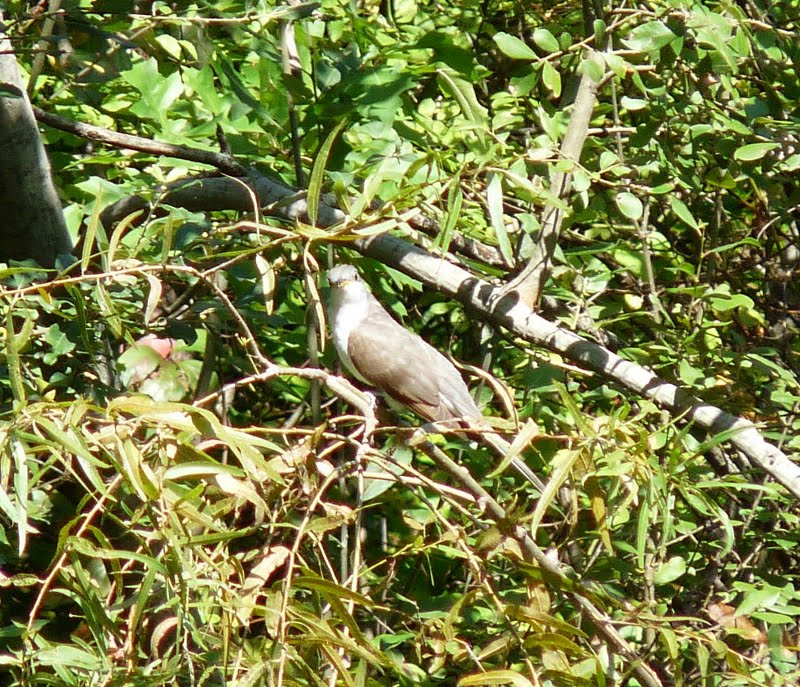
I squeezed some time into my morning to try to relocate it, and while I was searching, I discovered a Yellow-billed Cuckoo. They are not particularly rare and breed across Connecticut, but can be tough birds to find and actually see due to their secretive habits. This individual was the most cooperative I have ever seen, feeding on the edges of the pond, even pausing for a moment to allow me to snap a few photos. It even took a good long look at me even though I was still about 30 feet away.


I mentioned it was around the "pond", and unfortunately, I am using the term loosely. This is the current state of the pond. While we are not in an official drought, localized areas of Connecticut are in desperate need of rain. Clearly this section of Fairfield is one of them despite the fact strong thunderstorms had passed through the area only about 15 hours earlier.


Let us hope the rain comes soon before the conditions become even more dangerous. Back to the birds - I put Yellow-billed Cuckoo sighting out on the public CT birding list and departed, intending to return later for another quick warbler search. I arrived to see our friend Tina Green looking for it, having already seen the seemingly sociable cuckoo. To my great surprise, I was able to locate the Connecticut Warbler within about a minute while we discussed it. It was in the perfect spot for the species, an area where Ovenbirds often show up in spring, a seemingly "forested" leaf litter area along the pond. It skulked around and disappeared after giving us a nice close look. We did not see it again, and I could not get any photos.
This is the second Connecticut Warbler that the Birdcraft crew has banded this fall. Can they go for three?! Stop by soon to see if you can pick one up. Perhaps today's birds will still be there tomorrow...
Photos © Scott Kruitbosch
I squeezed some time into my morning to try to relocate it, and while I was searching, I discovered a Yellow-billed Cuckoo. They are not particularly rare and breed across Connecticut, but can be tough birds to find and actually see due to their secretive habits. This individual was the most cooperative I have ever seen, feeding on the edges of the pond, even pausing for a moment to allow me to snap a few photos. It even took a good long look at me even though I was still about 30 feet away.

I mentioned it was around the "pond", and unfortunately, I am using the term loosely. This is the current state of the pond. While we are not in an official drought, localized areas of Connecticut are in desperate need of rain. Clearly this section of Fairfield is one of them despite the fact strong thunderstorms had passed through the area only about 15 hours earlier.


Let us hope the rain comes soon before the conditions become even more dangerous. Back to the birds - I put Yellow-billed Cuckoo sighting out on the public CT birding list and departed, intending to return later for another quick warbler search. I arrived to see our friend Tina Green looking for it, having already seen the seemingly sociable cuckoo. To my great surprise, I was able to locate the Connecticut Warbler within about a minute while we discussed it. It was in the perfect spot for the species, an area where Ovenbirds often show up in spring, a seemingly "forested" leaf litter area along the pond. It skulked around and disappeared after giving us a nice close look. We did not see it again, and I could not get any photos.
This is the second Connecticut Warbler that the Birdcraft crew has banded this fall. Can they go for three?! Stop by soon to see if you can pick one up. Perhaps today's birds will still be there tomorrow...
Photos © Scott Kruitbosch
Thursday, September 23, 2010
White-tailed Kite Day 53
The White-tailed Kite is still at Stratford Point. I know many people from other New England states, the Mid-Atlantic, and maybe even some in Connecticut have not seen the raptor and are still looking for the time. There have been people from all over the nation still coming for their first visit. This weekend is your big chance. The kite was present Wednesday evening, and will therefore be there today. As we have the cold front that came by earlier tonight lifting back through as a warm front later Thursday there is no real conducive weather to move. The odds are very high it will be there Saturday and Sunday (at this point when would they not be?).
 The kite sitting in its favorite tree before eating a meal (see it?)
So why is this weekend your shot? The Great Stratford Bird Festival. As previously mentioned, it takes place from Friday through Saturday, with many events at Stratford Point. This means it will be open on a fairly regular basis. Considering all of the activity the kite may be pushed out to Short Beach or during some of the time. Nevertheless, if you come by early or late you have a good chance of seeing it with the gate open and staff on hand to help you out. Even if it is not on the property, we may be able to locate it for you. You can also enjoy various exhibits, bird banding, guided walks, and live raptors (other than the White-tailed Kite, American Kestrels, Peregrine Falcons, Merlins, Northern Harriers - Stratford Point has been busy lately!).
 A tired-looking kite preening just after dawn
If you have not seen the kite, believe me, it is worth your time. The Great Stratford Bird Festival will make that time even more enjoyable. Please come visit us and participate in some of the activities.
Photos © Scott Kruitbosch
Wednesday, September 22, 2010
I see a Red-breasted Nuthatch...everywhere
Nocturnal passerine migrants continue to pour into Connecticut. Though I have not had the chance to go out and find these birds on the move most mornings, it is obvious that the Red-breasted Nuthatch is in the middle of an irruption. An irruption is a rapid and often seasonal population increase in areas where a species is only rarely or infrequently seen. It is largely due to ecological factors such as a lack of the preferred food sources in the normal wintering range. The birds head south to find more to eat. This happens for species spanning the spectrum from crossbills to raptors, with Rough-legged Hawks and Snowy Owls having had irruptions in the state in the past few years.
 I didn't have time for photography in the middle of the survey at Fairfield University, and this Red-breasted Nuthatch was quite active, foraging all around me but not cooperating and pausing for any decent shots
Sizable numbers of Red-breasted Nuthatch are continuing a journey south through Connecticut. If you have not seen or heard one yet this year you probably will soon. Yesterday I heard one in my yard near my feeders as I walked out to my car. From there I heard another on a large spruce near the Boothe Park hawk watch site. Finally, I heard and saw yet another while surveying a portion of the Fairfield University campus. In southern Connecticut this is a species you could expect to see one or two of in the fall, if that. You would likely have to be outside very often to get lucky enough to have one every year, or know a precise location where they appear annually. In the past couple of weeks I think I have encountered more Red-breasted than White-breasted Nuthatch, which is completely absurd. If the trend continues we may have so many that they end up as a common feeder bird this winter. They are quite tame, so if you have not had them visit in your yard before you may be in a for a treat. Maybe you will get one to take seed from your hand. Listen for their loud distinct calls that sound like a stronger and more nasal version of the White-breasted Nuthatch.
Photo © Scott Kruitbosch
Subscribe to:
Posts (Atom)