Monday, August 2, 2010

Stratford Point this afternoon...

After posing patiently for the better part of the day, the White-tailed Kite on Stratford Point left us for a few hours by mid-afternoon. The weather had gotten pretty hot and humid by then and it appeared that the bird was ready for a siesta in the shade. Intrepid birders spotted it shortly after it disappeared in the top of a tree lining the north end of our coastal grassland management area. It was not visible from Stratford Point, but okay views were to be had from Riverdale and Ryegate Roads and several people watched from there. Frank Gallo dropped by with a group of kids from his Expeditions Summer Camp, who had all patiently scanned the skies above Stratford Point for quite a while already and were ecstatic to finally get a look at this rarity. Locals and neighbors joined us to see what all the commotion on their streets was about and in no time birdwatchers of all ages were getting a glimpse of the kite in the tree top.

Frank Gallo with his Expedition Summer Camp group and several other birders check out the kite


Several dedicated birders kept watch while the White-tailed Kite took a break from the excitement. Their patience was well worth it once the bird took flight again and started hunting over Stratford Point again.


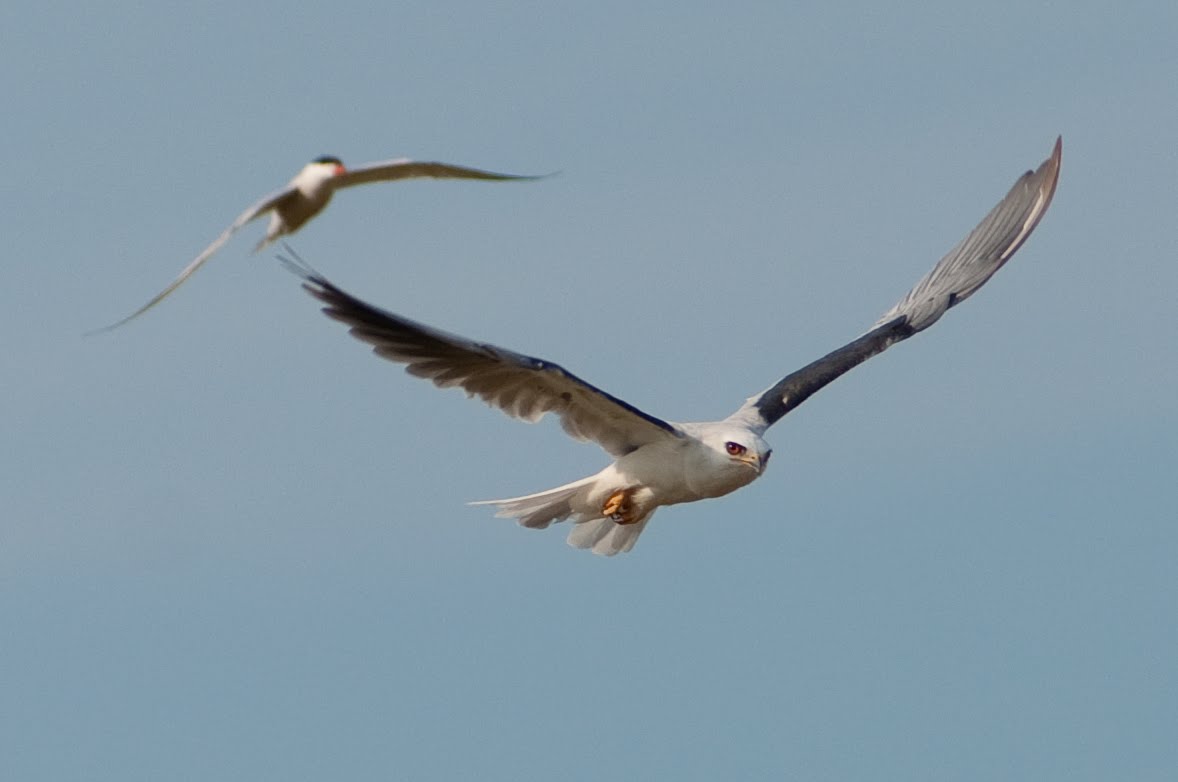
Around 5:30PM the White-tailed Kite left its tree-top hideout and strafed the grassland area on Stratford Point in search of prey, giving great looks.


It would occasionally venture out over the shoreline, alertly scanning its surroundings. Just like yesterday, the bird was constantly harassed by the many Common Terns that frequent the area. The video that Scott took yesterday shows how intense life for a raptor can get at times! The number of terns surrounding the kite was quite amazing and it was regularly immersed in a cloud of them.


The White-tailed Kite surrounded by several Common Terns. The kite is the bird on the bottom left of the flock (click on the image to enlarge it for a better view)


Even though it was constantly being harassed by other birds, the kite still hovered repeatedly. It did not seem to be bothered in the least by the swarm of terns buzzing it. I just heard that it was quite successful in its endeavor and managed to catch another meadow vole this afternoon. So far this bird has little reason to abandon Stratford Point and we're all hoping it will still be present tomorrow morning!

Common Tern in hot pursuit!


I wanted to thank everybody who visited Stratford Point today for being such responsible birders. It was fantastic to see people from 9 to 90 years old get equally excited about a bird, and it was especially nice to see that everyone kept a respectful distance so that the kite would not be disturbed in any way, making it possible for many people to get fantastic looks. Hopefully we will receive many more equally fantastic visitors to Stratford Point, both human and otherwise!


All photographs copyright Twan Leenders

White-tailed Kite Update

The White-tailed Kite continues to be seen today at Stratford Point. It was spotted just after sunrise on the Stratford Point property. After an active start to the day it mostly sat in its favorite small tree not far off the beach on the north end of the site, preening and bobbing its tail incessantly while keeping an eye on everything. Occasionally it would pop up and fly low out over the water, or over other parts of the property. Sometimes this was for a quick hunting trip, and sometimes it was because of people walking by it on the beach that did not even realize it was there.

For most of the afternoon, around 1:00 to at least after 5:30, the bird sat in a tree in a yard adjacent to the north side of the Stratford Point property. A crowd had gathered in the area trying to catch a glimpse of it buried in the leaves and branches. It kept itself in the shade, probably as a way to rest and keep cool on the increasingly hot and humid summer day. It certainly seems likely that it will be here for another day. I hope that it will be as cooperative as it usually is early tomorrow. For the past two mornings, it has put on a show for thrilled Connecticut birders and many excited visitors who made long journeys from neighboring states. It seems to wander and rest a bit more in the afternoon hours.

Yesterday some of us were wondering how much the White-tailed Kite had gotten to eat. No one I spoke to had noticed it catching any prey, whether it be rodent or insect. However, a couple of photographers were able to see that it had in fact found a couple meals. Below are two photos from Paul Fusco.


A close-up of the prey, a vole:


Looks as if the White-tailed Kite is doing wonderfully.


Photos © Paul Fusco

Sunday, August 1, 2010

White-tailed Kite at Stratford Point

This morning around 8AM Dennis Varza spotted a White-tailed Kite from Short Beach in Stratford looking at our own Stratford Point! He got the word out to the CT email birding list in the 9 o'clock hour - thank you Dennis! Charlie Barnard and I headed down there as fast as we could. Charlie arrived a couple minutes before I did, and he found it flying over the back field of the point as I frantically ran from my car to see it. We ran around even more to obtain record photos in case it departed. Thankfully, the bird stuck around for hundreds of visitors from multiple states. I was there until after 6Pm. It was at Stratford Point for most of today, though it also visited Frash Pond, the airport, and the landfill behind Short Beach. It certainly seems to enjoying hunting all over both IBAs. This will be a first state record, and there are very few records anywhere in the northeastern part of the nation. Congratulations to Dennis!

I do believe I have the honor of saying that I spent more time with the bird than anyone else...at least so far! It may stick around. After nine hours at Stratford Point I need to rest up for tomorrow, though I will post a detailed post concerning its hunting techniques, interactions with other birds and people, flight, size and plumage, etc. soon enough. It was endlessly fascinating to study.

For now, here are some photos from CAS Coastal Center Director Frank Gallo and myself, along with a video of the bird. It was tough to shoot while learning how the kite moved, not shaking the camera since there was no time to put it on a tripod and be close enough for HD video, and the fact it was not stationary much beyond hovering or sitting on perches very far from everyone. Maybe, if we get a day 2, I will be able to do better.

Frank's photos:


A few of the many visitors

My cropped but unedited photos:

The first photo ever taken of the bird!


With a swallow going after it (the swallow is closer and appears larger)


My video that also shows how the many Common Terns attacked the White-tailed Kite frequently, often driving it into other areas:


White-tailed Kite from Connecticut Audubon Society.


Photos 1-5 © Frank Gallo; photos 6-8 and video © Scott Kruitbosch

Thursday, July 29, 2010

Other Stratford Point updates...

Things have been a bit busy lately so I am a little behind on my blog posts. Scott has been keeping you updated on the bird sightings and avian activity on Stratford Point, but there are other things happening there as well that are noteworthy. Most importantly, two developments concerning the wildlife habitat of the site are worth a closer look.

For those of you who are not familiar with the site, Stratford Point is essentially a peninsula that juts out into the Long Island Sound just west of the mouth of the Housatonic River. The site comprises 28 acres, much of which we manage as a coastal grassland. Grasslands, if left to their own devises, will eventually turn into scrub land and vegetational succession will ultimately cause the area to become forest. Grassland can only remain grassland if it is intensely managed. Grazing or mowing are the most commonly applied management practices, but both have drawbacks. Historically there were fairly extensive grassland areas along the Connecticut coast and most likely these areas remained grassy because of periodic fires, triggered by lightning.


Grassland management through controlled burns is a preferred management strategy that allows for the removal of all aboveground vegetation without soil compression from mowers or grazers, it does not result in the accumulation of downed vegetation on the ground (which can cause problems because it creates habitat for unwanted mammals and may hinder the regrowth of new shoots in spring) and it does not leave the site with excessive nutrients from all the biomass that is left to rot. Most sensitive plant species in the state require nutrient poor soils - which are hard to come by nowadays with the massive amounts of fertilizers used everywhere.

We are looking into the possibility of having a series of small controlled burns carried out at Stratford Point to manage the unique habitat that the site sustains. Obviously, these kinds of practices require a ton of permits and oversight and we are a long way from actually doing anything, but last week we convened representatives from the Department of Environmental Protection (who authorizes and oversees controlled burns in CT), the state's Forest Fire Service, and the Town of Stratford to join us on a site walk and take a first look at the feasibility of this plan.

Everyone is excited about the concept and wheels were set in motion. We are now in the process of officially applying for state authorization to carry out the burns and will go from there. I will definitely keep you posted on developments on this front.

Other habitat management-related news can be seen on the shore of Stratford Point. I am in the midst of carrying out a feasibility study to determine whether it will be possible to bring back Saltmarsh vegetation (Spartina alterniflora) to the intertidal zone of the site. Years of remedial activities on-site have led to the disappearance of all shoreline vegetation and the fauna that depends on these plants. To my great surprise I noticed this week that one of the recent storm events had altered our beach enough to create conditions suitable for Spartina to grow and in the last three weeks several plants have grown in! I counted no fewer than 79 individual plants spread over a substantial sections of the beach -- hopefully future habitat management work will allow us to bring back the original vegetation to Stratford Point.
Several small Spartina plants have recently sprouted around this newly formed tide pool

If you are visiting the site, please tread lightly around these plants to allow them to recolonize the beach and form a solid foothold for next year's growing season.
Yes, as you all know, the shorebirds are back in town again. However, I wanted to briefly introduce you to two other inhabitants of Stratford Point which I encountered this week.
Semipalmated Plovers are now regular visitors to our shoreline again
As I was surveying the new Spartina growth on the beach earlier this week, I came across another Lion's Mane Jellyfish like the one Scott reported from the Warehouse pools on Long Beach Boulevard last week. Nick Bonomo commented that he has seen many of these animals in the New Haven area recently. I have no idea why they are suddenly this common on our beaches, but it sure is interesting to see these sudden appearances of rarely-encountered species. Any suggestions are certainly welcomed!
Lion's Mane Jellyfish on Stratford Point beach
Another visitor actually dragged me away from my computer (which is easily done) as I watched it run around on my office window, trying to snag one of the many yellowjackets that had taken up residence in my AC unit.
Believe it or not, this Chinese Praying Mantis is actually Connecticut's state insect! An exotic species introduced for pest control! Even though these guys are not necessarily very rare, they are not frequently seen. And although I do encounter them fairly regularly, I have never had the pleasure of watching one walk on the sky like this one!
Chinese Praying Mantis (Tenodera sinensis) poised to snag a passing insect
All photographs by Twan Leenders

Many hands & many eyes make light work

During the summer months CAS Science & Conservation staff spends much time in the field doing survey work. Whenever possible we try to share our experience with young people from around the state. In the past two weeks I was accompanied by a group of volunteers from the Beardsley Zoo's Conservation Discovery Corps who helped me survey our Pratt Valley Preserve in Bridgewater.
A dramatic hemlock gorge bisects this 150-acre sanctuary and we surveyed this area for the presence of state-listed species of animals and plants, as well as any conservation priority species. It was a scorching hot day with some severe thunderstorms in the area, so everything kept quiet and mostly hidden from view.
Nevertheless, our search revealed several species of amphibians and a substantial list of birds. Unfortunately, the only bird we detected inside the gorge was a Northern Waterthrush. Although this species breeds here, the bird we saw may have already been an early migrant.
Sections of the Pratt Valley Preserve are still actively farmed, while other sections are managed for early successional habitat. Prairie Warblers, Indigo Buntings, Eastern Towhees and Gray Catbirds are common breeders here. Even though the heat kept animal activity down, it did not stop us from doing a thorough inventory of the non-native plant species that occur in the sanctuary. Hopefully targeted habitat maintenance work will help to keep these invasives in check!

A few days later a group of energetic summer campers from our Coastal Center in Milford bravely followed their leader, Frank Gallo, and joined me at our Croft Preserve in Goshen. You can see them in the above photograph, enjoying a well-deserved lunch break in one of our early successional habitat mangement areas after a long and strenuous hike into the middle of this 700-acre forest.

These guys did a fantastic job spotting critters big and small and we ended up with a good list of species by the end of the day! Luckily not many invasive plants here.

Some of the proud volunteers show off a Redback Salamander we found. However, the most exciting thing for this group was undoubtedly that they had a three mega-mammal day, managing to see a Black Bear on the roadside before arriving at the preserve, finding numerous Moose signs around the preserve and getting amazing looks at an American Porcupine in a tree during our lunchbreak. I don't think that there are many people in Connecticut who can boast such a trifecta in one day!

This American Porcupine gets a little testy and retreats with all quils at the ready!
It is such a treat to be able to spend time in the woods with kids and hopefully many of them will be back with all their friends. These kinds of experiences certainly stay with you for a lifetime! And I have to admit that all those extra hands and eyes really make a my work seem like a walk in the park....

All photographs by Twan Leenders

Upcoming special events

The following is a short list of Connecticut Audubon Society special events in the next couple months. Your participation would be greatly appreciated. If you click on the links at the end of each bullet point you can find more information on the main CAS website.

• Aug. 5 at 8 PM, "Bird Songs": Concert of Choral Music “For the Birds” at Christ Church in New Haven to Benefit Connecticut Audubon Society. Features debut of 16-member “Earthly Sound” Vocal Ensemble. Donations collected at the door. More information.

• Sept. 17 "Harvest Dinner Under The Stars” Celebrates CT-Grown Foods and Benefits our Center at Glastonbury, starting at 5 PM with a wagon tour of 100-acre Rose’s Berry Farm. More information.

• Sept. 20, our 2010 "Let the Birdies Fly" Golf Tournament and Fundraiser at TPC River Highlands in Cromwell, CT. Get player and sponsor information.

• Oct. 1-3, Inaugural "Birds In Their Habitat" Juried Artists’ Preview Party, Exhibit & Sale at our Center at Fairfield, featuring 2010 Artist of the Year James Prosek and Works by 22 Select Artists. More information.

Tuesday, July 27, 2010

Common Terns

Below is a short video of juvenile Common Terns close to the shore at Stratford Point. One is fed a fish by an adult while others, not young of the adult, nevertheless beg for food. It makes short work of its meal and is begging for more the second the fish is handed off. The video was shot with only the optical zoom of my camera - imagine the great looks you get from a scope!


Common Terns from Connecticut Audubon Society.


Video © Scott Kruitbosch