Wednesday, August 25, 2010

Manatee?

Courtesy of WTNH, the following video details a Manatee that was seen in Clinton Harbor.


This is yet another southern visitor to Connecticut this summer. Apparently, a Manatee was seen in Bridgeport and perhaps Fairfield last week as well. This is very likely the same one. I am certainly not a marine mammal expert, but with that said I imagine this sighting was either because of climate change, or at the very least made more likely to occur because of it. The fact we may be in the midst of the hottest year ever certainly helps. This of course comes right after our discussion on the Striped Burrfish found at the Coastal Center at Milford Point.


Video courtesy WTNH

Monday, August 23, 2010

White-tailed Kite and Cattle Egret

Day 23 of the White-tailed Kite watch was a tough one for the poor raptor. After a night of torrential rain this morning started with still more rain. The bigger story was the wind. Right on the coast, and on Stratford Point property, wind gusts were well over 30MPH, nearing 40 at times. This northeast wind was sustained at around 20 to 25 or even 28MPH. Twan spotted the kite this morning over Great Meadows Marsh in the Stratford Great Meadows Important Bird Area. This was by the airport just to the northwest of Stratford Point. It has been seen in this area several times in the past. Obviously, this is a more sheltered area to hunt in, protecting it much more from the elements. However, the salt marsh habitat does not have near the quantity, density, or variety of small mammals the kite almost exclusively feeds on.

I spent some time measuring the wind speeds at Stratford Point while watching for rarities like Wilson’s Storm-Petrel, as our friends Bill Banks and Greg Hanisek saw one earlier in the day. This type of storm system, with such strong northeast winds, is perfect at bringing birds to the coast that you would normally only find out on the water. I was also waiting for the White-tailed Kite to return for its evening meal.

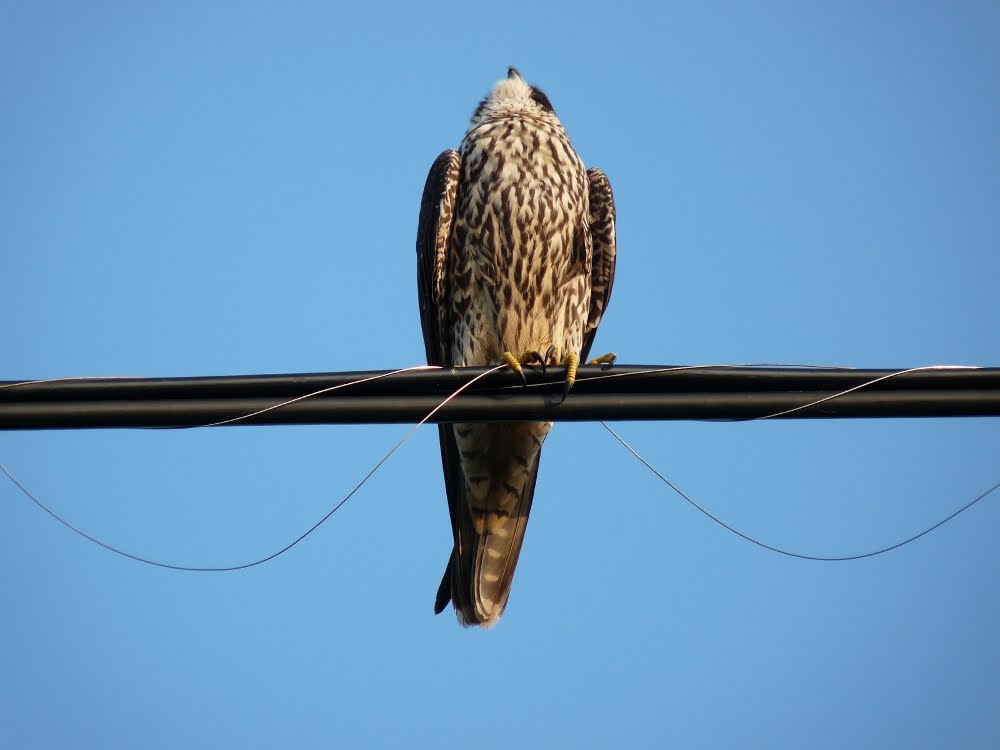
Not the White-tailed Kite. From last week, the infamous banded Milford-born juvenile Peregrine Falcon asking me "Where's the kite now?" while looking for it for another fight.

Sustained winds were in the 25-28MPH range, gusts to the mid-30s. At about 5:08PM I saw what I presumed was a distant Snowy Egret flying towards the point with the wind, going southwest. As it came in closer, I noticed with the naked eye it had all very dark legs and feet - not a Snowy. Staring at it in my binoculars as it passed close in front of me over our Purple Martin gourds, I noticed it was small, had a short black bill with some light yellow only near the base, and had quite a thick, large chest and neck for its small size. However, the size and shape cannot be relied upon fully with the strong wind making for some oddly shaped flying birds. For what it is worth it stood out to me. The legs and bill were wrong for a juvenile Little Blue, and it was obviously not a Great. It was a juvenile Cattle Egret.

In that wind and with the limited observation time there was no way to get a picture of it and still get the important great looks at it that I had. Unfortunately, it kept going past the Stratford lighthouse that is next to Stratford Point, so the only hope now is to keep an eye out for it on the coast to the west. You cannot come see this one, similar to the Brown Pelican. I wish everyone could. While I went inside to check for more information on what I had just seen the kite reappeared. A subsequently happy man named Tom said it came in around 5:15. It hunted for about five minutes before seemingly flying off. I do not know if ate or not. Obviously, it was very difficult to fly or hover with the winds, even for the kite.

It goes without saying that tomorrow, as windy and rainy conditions continue, will be a great day for shorebirds and rarities of all sorts on the coast. Please come to the seemingly unstoppable Stratford Point to see what you can find - you know, besides the White-tailed Kite. What a ridiculous month. Here are a couple more White-tailed Kite photos via Karen Fung - thanks! I receive many of them each day, but please send some if you like and perhaps I will put them in an entry.


Diving for prey...


...and flying with prey.


Photo 1 © Scott Kruitbosch; photos 2-3 © Karen Fung

Saturday, August 21, 2010

Striped Burrfish

Last Sunday something very strange was discovered by a young boy on the beach of the Connecticut Audubon Society Coastal Center at Milford Point. This non-avian discovery made its way to Director Frank Gallo. Our own Conservation Biologist and fellow blog author, Dr. Twan Leenders, took the following photographs.


He, in consultation with scientist friends and former colleagues, identified it as a juvenile Striped Burrfish. This is a species of puffer fish. We are still waiting to hear back from experts about its frequency of occurrence, and whether or not this sighting is rare or simply uncommon in this part of Long Island Sound. Twan did tell me that it shows up in the New York area in late August and September. He therefore assumes that there is some cyclical cycle, whether it is seasonal or reproductive, behind its appearance in more northern east coast regions.

A nice summary of the species is available here from the South Carolina aquarium website. Their species profile also suggests it is “rare north of North Carolina”, though the definition of rare can certainly vary. I would surmise it is infrequently found inhabiting some of the warmer waters of the Mid-Atlantic, and that it is indeed rare in Long Island Sound. I would also take a leap and hypothesize that during the hottest year ever recorded by humans the warm water temperatures are allowing many species to move a bit more north. A recent article in the Connecticut Post discussed how research in Long Island Sound has shown more warm-water and tropical species occurring in the waters. This is climate change in action. Just like the birds around us the countless lifeforms in the Atlantic Ocean are quickly adapting and changing to this new reality.


Photos © Twan Leenders

Friday, August 20, 2010

White-tailed Kite Day 20

The White-tailed Kite has altered its schedule a bit lately, spending more time at Stratford Point in the morning and less in the evening. This is likely because it is able to be there without too many people around, if any. It is becoming well versed in our schedules and habits. While I do not think anyone bothers it, and certainly not in the evening, it would be silly to ignore the discernible pattern that has emerged. It is a highly-intelligent raptor. It knows how to avoid the crowd by this point of its stay. At least we can all be happy it is still here, eating plenty, and offering some good views at times.

Here is an amazing shot of the kite's eyes from David Speiser:


In my last video I showed the kite scratching itself, and Lou Spero got a shot of it:


Big thanks to them! If you have not come out to see the White-tailed Kite get here while you can. It will likely stick around a bit longer, but you never know. Stratford Point and the Coastal Center at Milford Point will be open this weekend.


Photo 1 © David Speiser, photo 2 © Lou Spero

Wednesday, August 18, 2010

Raptor updates: White-tailed Kite and Osprey

Well, Scott just let me know that the White-tailed Kite was not seen tonight by the small group of kite-spotters waiting patiently at Stratford Point, nor was it detected in its regular hangouts at Milford Point. However, several people got great looks this morning and the bird was unusually visible on-and-off all morning as it hunted over the coastal grassland management area at Stratford Point. I guess it just deviated from its routine a bit - which was not entirely unexpected after hunting unsuccessfully last night. The cooler weather this morning allowed it to chase prey for a longer time and perhaps it just called it a day with a full stomach by lunchtime? I last saw the bird around 11:30AM flying past my office window, but did not have time to keep an eye on it after that. Hopefully it will be back again tomorrow morning. Time will tell...

Meanwhile on the other side of the river, daily routines are getting crazy too. The young Osprey at Milford Point are getting rowdier with each day as they learn to catch fish or fight over the food that mum and dad bring in. Of course these babies are now the same size as their parents and things are getting a little crowded in the old homestead (keep in mind that an adult Osprey has a 5+ ft wingspan!). As you can tell from Kevin Doyle's photos below, their nest is slowly starting to fall apart from all the use and abuse it suffered in the last few months.... all signs are there: the time for these guys to head south on their first big journey is approaching rapidly!

Chunks of debris fall off the Osprey nest as one of the birds takes off
The rowdy bunch!

Another quick Osprey update is in place here too: I spoke with one of the owners of "Wildlife in Crisis" this morning to get a status update on the Osprey that Scott and I rescued from Pleasure Beach a while ago. The bird suffered a dislocated shoulder and is recovering but only slowly. Apparently it spent a long time early on escaping from its bandages, which slowed down the recovery process. Even though the shoulder is now healing well, the bird has been in a fairly small cage still to facilitate its feeding (it has to be hand-fed, which is hard to do in a larger enclosure!). As soon as its shoulder has sufficiently healed it will be allowed to move into a flight cage where it can rebuild its strength - which will hopefully be very soon. At this point it is not clear yet whether the Osprey will be fit to be released before its migration window closes, or whether it will need to sit out the winter in its temporary home in Connecticut. We'll keep you updated here!
Photographs by Kevin Doyle

Monday, August 16, 2010

White-tailed Kite Day 16

The White-tailed Kite continues! Our own Dr. Twan Leenders reported that, as usual, it was hunting at Stratford Point this morning. I will be there this evening as more visitors stop by for a chance to see it up close. Last night was the first evening since August 7th that it did not return to hunt for one last meal, disappointing many people who could only see it about 1.25 miles away on the cedar trees of Milford Point before it flew off for the night. I am sure everyone remembers the two battles the kite has had with juvenile Peregrine Falcons. The first was an unbanded young falcon, while the second had a band I was able to read to send into the DEP.


You may be able to see the band on the leg of the Peregrine, just a dark larger than usual blob on its left leg, in the shot above. Julie Victoria of the Connecticut Department of Environmental Protection banded this bird at the nest box on May 25, 2010. It was at the NRG energy plant that is in the Devon section of Milford, Connecticut. This is only three to four miles up the Housatonic River, which of course forms the estuary that Stratford and Milford Points surround. Julie also told me that, due to construction, she has not been able to band the young Peregrines from the nest box in Bridgeport that is on the I-95 bridge. She surmises that the unbanded juvenile attacker is likely from this nest.

Peregrine Falcons are known to move about quite a bit, though it was not too much of a surprise to learn this young raptor was still close to its birthplace. One Peregrine I had at Long Beach in Stratford on January 3, 2009 was a female who was banded on a building in Providence, Rhode Island in May 8, 2006. Tracking the dispersal of young is important beyond our curiosity, too. It will be fascinating to see if the banded individual remains in the area.


Finally, here is some other information on Connecticut Audubon Society events at Milford Point from CAS Coastal Center Director Frank Gallo - maybe you will see the kite up close while in a canoe!

It was a full house on our canoe tour, Saturday, with 10 canoes and 3 kayaks joining us. Late summer and fall are exiting times to paddle the marsh; you just never know what will turn up. Saturday's intrepid paddlers were treated to great views of roosting herons and egrets, including 17 Yellow-crowned Night-Herons (our high so far this season), 1 Black-crowned Night Heron, 9 Great Egrets, 1 Snowy Egret, as well as quick looks at a Saltmarsh Sparrow and views of a number of different shorebirds. The swallow migration is in full swing, and Barn Swallows along with a few Tree Swallows were streaming by during the entire trip. Ospreys were everywhere and our resident young Red-tailed Hawk was screaming to be fed from the trees near Court Street.

Our next canoe tour is Aug. 28, 12:45-3:15 p.m. It is filling quickly, so please call soon if you would like to reserve a space. There are several tours in September, and the full fall schedule is listed on the Coastal Center's page on the right. There will be a special fall foliage tour on Sunday, October 24, 11:00-1:30 p.m. that should also be good for waterfowl. We're looking forward to it. If you're planning to attend the Stratford Bird Festival on Saturday, September 25, spaces have been reserved for birders on our 11:30-2 p.m. canoe tour.

Our first birding class of the fall is:
Sorting Out Bird Songs
Wednesday, September 15, 7 – 9 p.m.
Birdsong can be an incredible aid to finding and identifying birds. Instructor Frank Gallo, an avid student of birdsong, will introduce the basics of birding by ear, using sound resources, as well as the tips, tricks, and even pitfalls to identifying birds by sound. Is that an oriole or a tanager singing? Could that be a hermit thrush calling or a catbird? Come find out, as we delve into the basics of birding by ear. Meet at the Connecticut Audubon Coastal Center at Milford Point. Fee: $35.

...and our first Charles’s Island walks are:

Charles Island Explorations
Wednesday, September 8 at 5:00 p.m. and Sunday, September 12 at 8:00 a.m.

Check the Coastal Center's page for details or call Louise at 203-878-7440 x 502


Photo © Scott Kruitbosch

Saturday, August 14, 2010

White-tailed Kite Day 14

Tomorrow will be two weeks since the kite was discovered at Stratford Point by Dennis Varza. It is in a perfect routine at the moment, having becoming accustomed to the human schedule while setting one for itself. It hunts early while we give it space, having a few meals from around sunrise to 8AM before leaving Stratford Point for Short Beach or Milford Point. It will come to Stratford Point once again for one meal later in the evening, between 5:30-7:30 mostly, sometimes staying until nearly 8. Visitors from many states keep making the trek to see this amazing raptor. Those who come during the previously mentioned hours nearly always leave with a big smile on their face. I may post more pictures soon, but since there have only been two videos from me compared to so many pictures from fantastic photographers, I thought more video was in order.

If memory serves (and it may not) I believe it is the first video of the kite perched. Keep in mind you can hover over the right-hand corner video of the video for the full-screen option. The shot shows it sitting on its feeding perch after a meal. This is where it takes most of its kills when it does not go to a telephone pole (because people or vehicles are there). After that is a hovering and soaring shot with a twist as it amusingly shows the kite scratching at its face in mid-air at a bug.


Video © Scott Kruitbosch