Thursday, February 3, 2011

Dead White-winged Scoter

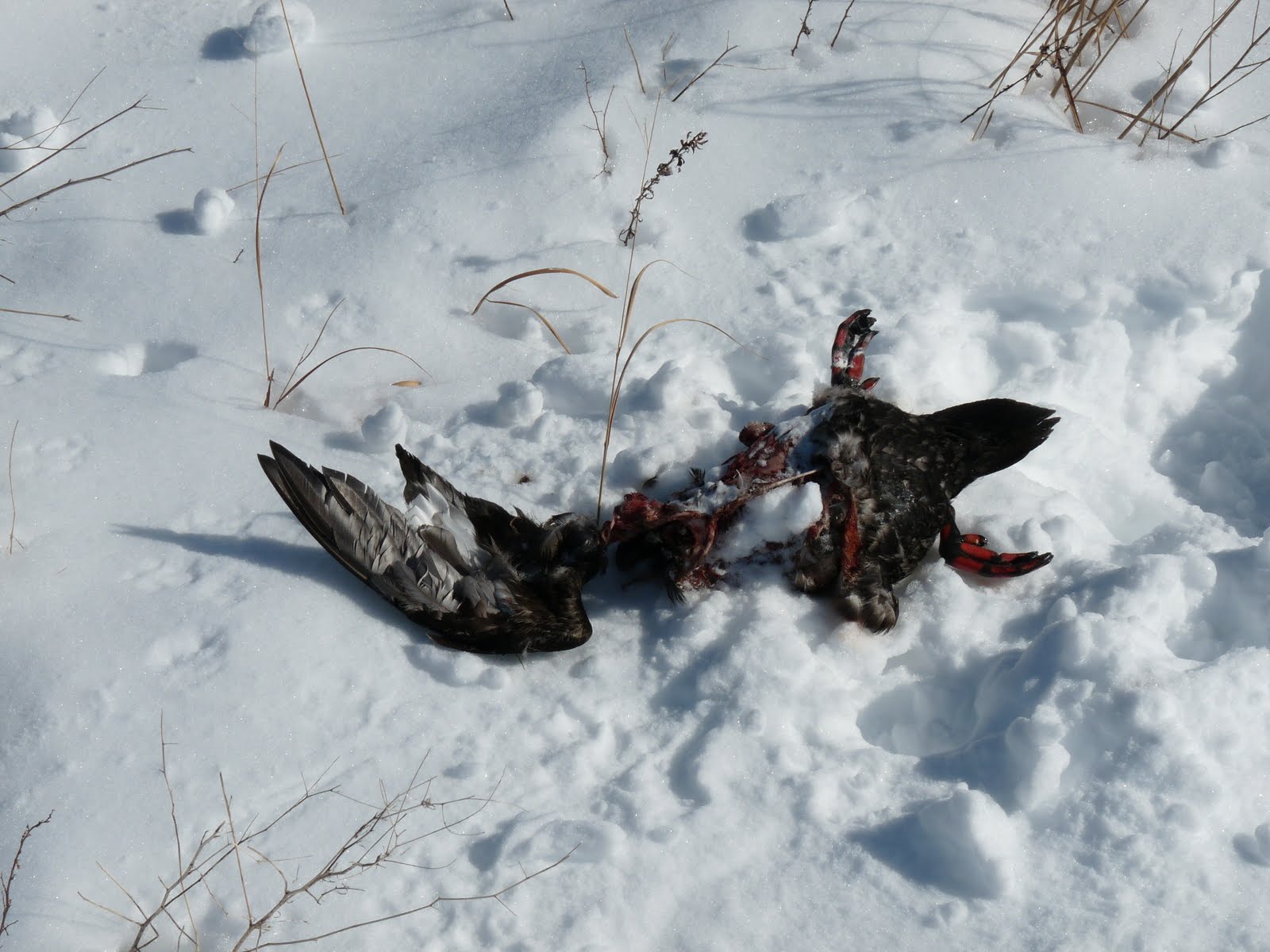
That is what it appears to be, at least. On Monday, before yet another winter storm, I wandered around the coastal grasslands Stratford Point after one of our typical waterfowl surveys. Wandering is not quite the right wrong for it. Since we have feet of snow on the ground, the area is only passable with snowshoes. I wear mine every day and can survey the area on our mowed paths with relative ease. However, the thick area of grasslands was difficult to traverse even with special equipment. I sunk straight through the snow up to my waist. Nevertheless, before I made my way out I discovered a carcass that appeared to be a White-winged Scoter. The large photo of the devoured duck is below - if you have a weak stomach do not click on it.


It was not far beyond our beach. How did it get there? That is a very good question, and one we cannot answer with absolute certainty. One theory was hunting, but I do not believe it was shot by hunters and washed ashore. It could not have been where it was without help, but there were no drag marks on the snow, so it was not brought off the beach by mammals after washing up. Hunting season also ended before the previous storm (it is hard to keep track, trust me on this one) and this was quite obviously on top of the all of the snow. It looked like it had been dropped from the air.

Twan agreed by saying that there was not any indication of scavenging or feeding in the snow surrounding the carcass, at least yet, but that clearly all the "good" parts had been consumed. He also made a particularly interesting observation, saying that there were no broken or smashed bones in the sternum area, which indicates that something without teeth was to blame. So that brings us to raptors...which one? Peregrine Falcon would be the most obvious choice, even with such a sizable prey. They are frequently seen in the area year-round, and as you can see in my last blog entry, a pair has been hanging out at nearby Long Beach during this harsh winter. They are listed as a predator for scoter along with Bald Eagles in the Birds of North America Online. Only exceptionally rarely are Bald Eagles seen at the mouth of the Housatonic River despite the fact they are frequently seen mere miles further up it.

The best guess then seems to be a Peregrine Falcon taking a sick or injured White-winged Scoter around Stratford Point then dropping the heavy kill there to eat in a quieter place. Even though they hunt for small mammals, I have seen Northern Harriers eat freshly killed ducks and geese when they are frozen in winter in Stratford. One or two of the many we get at Stratford Point in winter may have helped to finish off this carcass.


Photo © Scott Kruitbosch

Tuesday, February 1, 2011

New Connecticut State of the Birds report presented by Milan Bull

Milan Bull to address Connecticut Audubon Society’s Connecticut State of the Birds 2011 Report

When: Saturday, February 5, 2011 at 10:00 a.m.

Where: Birdcraft Museum, 314 Unquowa Road, Fairfield, CT 06824

Who: Milan Bull, CAS Senior Director of Science and Conservation & report co-editor

Event: Release of Connecticut State of the Birds 2011 report.

Connecticut Audubon Society’s Connecticut State of the Birds Report, 2011 reveals new and startling information about our forests and the birds that depend on them. Did you know that for the first time in over 200 years our forest resources are declining permanently? Fragmentation and parcelization are reducing our forests into smaller and smaller blocks that can no longer support productive populations of forest-dependent birds. Wood Thrushes, for example, require over 400 contiguous acres of unfragmented forest in order to reproduce productively.

Unlike the past changes in our forests, when they have been converted to agricultural and wood product use, then regrown when abandoned, our forests are now disappearing due to “hard development”, highways, residential and commercial development that permanently destroy forests that may never return.

Find out what Connecticut Audubon Society is doing to help plan a vision that will conserve and protect our important forest resources while maintaining and expanding the economic and natural resources our forests can provide now and into the future.

Free to Connecticut Audubon Society Members and $5 for non-members. To register or for more information call 203-259-6305 ext. 109.

Visit Connecticut Audubon Society’s website at www.ctaudubon.org for a complete listing of programs and special events.

Sunday, January 30, 2011

Birds of late January

So what have we seen lately in the snow? Not much...though word comes today that our friend Tina Green may have found the first Common Murre for the state of Connecticut at Hammonasset Beach State Park in Madison. Congratulations to her! Here are some photos of some of what else has been going on...

This male Eastern Towhee decided my yard was a fantastic spot and has moved in for the time being. I wonder where he was until now!


A more surprising yard visitor has been this Field Sparrow, a rare bird in Connecticut in winter. I have never had one visiting my bird feeders before, though I have heard of it happening in adverse conditions.


A pair of Peregrine Falcons has been hunting at Long Beach in Stratford on a regular basis. They can often be found sitting in the small trees or the power lines near the entrance to the beach.


My Dark-eyed Junco with unknown eye-rings is still here. It certainly does look like some type of fungus or infection, but the bird seems fine. Perhaps it is something else...


Finally, these three male Redheads were with a female at Stratford Point on Friday.


The species has been seen in the area often recently, from one to four birds at a time. Stop by to see them soon before they're gone.


Photos © Scott Kruitbosch

Friday, January 28, 2011

Snowstorm Birds

The historic snow continues! Yesterday, Bridgeport's airport in Stratford set records for both all-time snow depth and snowiest January ever. Yes, you can read that again, and it is true. However, on second thought, you may not need to be convinced of it. The snow is everywhere. The bad news is more will be coming soon. Below is an old video I shot on December 18-19 of 2008 of the birds coming to my feeders during the first snowstorm of that season. What better time to share it?

Snowstorm Birds from Connecticut Audubon Society.


All of the birds are common backyard species except for the Rusty Blackbird male and female who decided to stop by for a snack during the harsh weather. Do not forget the Rusty Blackbird Blitz starts tomorrow!


Video © Scott Kruitbosch with music © the ZREO team

Wednesday, January 26, 2011

Snow, snow, snow!

As we are being blanketed by yet another storm, I wanted to share a few pictures with you from yesterday's snow (which was forecast as essentially a dusting...alas).

The lighthouse on Stratford Point - this picture was taken around noon, but the snow and clouds blocked much of the light.

It is not a surprise that this year we have had no meadowlarks wintering in the site's coastal grassland habitat...
Ring-billed Gulls patiently sitting out the weather

The shoreline was active as ever with hundreds of waterfowl and gulls present in the intertidal zone. You just could barely see them!

This Greater Black-backed Gull is starting to accumulate some snow on its back.

Once the snow cleared, business returned to usual

Snow-topped rocks in the splash zone look out of place!

This is one of the three male Redhead that showed up at Stratford Point yesterday. These are likely the same birds that have been showing up in other areas lately. It appears that we are having a good winter for these pretty ducks!
All photographs (c) Twan Leenders

Monday, January 24, 2011

Rusty Blackbird Blitz

This year’s Rusty Blackbird Blitz is only five days away! The 2011 Blitz is scheduled for January 29 to February 13. For those 17 days scientists, birders, and other volunteers will look for Rusty Blackbirds in their potential habitats, focusing primarily on all of the states to our south. However, Connecticut holds a decent number of Rusty Blackbirds in winter, even in harsh ones like this year. Recent observations have shown they are still present, sometimes in sizable groups, in areas ranging from Westport to Woodbridge and Hamden to Sterling and Litchfield. I am sure there are more out there, whether they be in wooded wetlands near neighborhoods like mine, in other preserves and sanctuaries, or among larger blackbird groups. We know of several locations they typically winter in, but we need to find more locations and more birds during that time period!

Male Rusty Blackbird

If everyone reading this who lives in Connecticut or any state with Rusty Blackbirds could be please so kind as to keep an eye out for them and log the results in eBird (http://ebird.org) that would be fantastic. You will be doing a great service to conservation and a species that is plummeting in number before our eyes. We would love to have as many details as possible - exact locations, the sex of the birds, what they were doing, what they foraged for, the habitat they were found in, and so forth. More information on all of this can be found on the Rusty Blackbird overview page on the Smithsonian's Migratory Bird Center website, I site I mentioned yesterday as it is home to the International Rusty Blackbird Technical Working Group: http://nationalzoo.si.edu/scbi/migratorybirds/research/rusty_blackbird/

If you have any questions about Rusty Blackbirds, the blitz, eBird, or would rather directly send me your Rusty Blackbird sightings during that time (or any time you see a Rusty Blackbird), please feel free to do so. Thank you so much in advance - I know we can find some "new" Rusty Blackbirds and all of you will provide us with some great information! While we are particularly interested in finding large groups of them, even just one Rusty Blackbird visiting your yard for a day in that period is very important (and so is their absence where they would be typically found). So, once again, please do not hesitate to email me about any of this.


Photo © Scott Kruitbosch

Sunday, January 23, 2011

Rusty Blackbird off depredation order

This is the first of two posts regarding the Rusty Blackbird, so please watch for the next one tomorrow. The once common species, that sometimes filled the sky during migration over a century ago, has shown both alarming long-term and shocking short-term population losses. It is actually one of the entire continent's fastest declining species. This fact is still not widely known among birders or scientists and until the past decade very little was done to even acknowledge the plight of the Rusty Blackbird, let alone discover the reasons behind it or address these problems. This changed when the International Rusty Blackbird Technical Working Group was formed in February 2005, a group that I am a member of - you can find more information on it here at the Smithsonian Migratory Bird Center's website: http://nationalzoo.si.edu/scbi/migratorybirds/research/rusty_blackbird/

Due at least in part to the group's work, blackbird control practices (the killing of large flocks of blackbird species in certain areas in order to protect agriculture, prevent disease being spread among livestock, etc.) have been reexamined. Effective January 1 the Rusty Blackbird was removed from the federal depredation order on blackbird species. This means they can no longer be killed for control practices without a permit (and no one is going to get one to do so). Further measures were also taken, and they are causing a bit of negative stir from expected sources.

The objections seem to come from the new reporting requirements for birds killed under the order and the new requirement that all shot be non-toxic (not lead). Lead can harm the Rusty Blackbird, as well as the environment and other species in numerous ways, so the legal killing of blackbirds cannot be done via lead shot. More reporting requirements were put in place so that we have a better idea of what/how/when concerning blackbird control efforts as well as ensuring the Rusty Blackbird remains protected. Blackbirds can no longer legally be taken without the appropriate documentation.

There is a short period that Congress can review and nullify these new rules but we hope that will not be the case. If you would like to look over the full details of the new rule, you can find it here: http://www.federalregister.gov/articles/2010/12/02/2010-30288/migratory-bird-permits-removal-of-rusty-blackbird-and-tamaulipas-mexican-crow-from-the-depredation#p-3

So what is next? The third Rusty Blackbird Blitz, January 29-February 13, where scientists and volunteers go into the field to record in detail every Rusty Blackbird they can find, with the results being put into eBird. I will post more information on that tomorrow. I hope you can join us then and help save the Rusty Blackbird!