Thursday, February 10, 2011

Find the bird answer

So did you find the bird in this photo? Take a look below!


That would be our Short-eared Owl peering back at Twan from a distance. It flew from this area around Stratford Point for a while before going back into hiding. Despite being early in the morning, quite hazy, and backlit, Twan got this great in flight photo.


It keeps eluding me! I have not seen one since October 18 at the Boothe Park Hawk Watch, when ironically it was another subject of name this bird.


Photo © Twan Leenders

Wednesday, February 9, 2011

Find the bird

Here is a photo Twan took at Stratford Point a few days ago. Can you find the mystery hidden bird? And we don't mean the duck in the water...


Photo © Twan Leenders

Monday, February 7, 2011

Barrow's X Common Goldeneye hybrid on icy Stratford Point

This morning I was fortunate enough to find the flock of Common Goldeneye and its associated hybrid Barrow's Goldeneye fairly close to the Stratford Point shore. Scott found this fascinating bird, as well as an adult male Barrow's Goldeneye, last Friday. He described these birds and his discovery in a previous blog post but was not able to get better pictures at the time. Hopefully these images will supplement his excellent description.


Note the different head shape and color, presence of an incomplete "spur" and the white markings high up on the back. The bird was still present late this afternoon (2/7) and may remain visible for those interested in seeing it in person.


On the day that Scott found these unusual ducks, I took a few scenic pictures of a completely ice-encrusted Stratford Point. Everything down to the smallest blade of grass was covered in about half an inch of ice, making it extremely treacherous to walk around there. However, the surreal scenery made it worth the effort.


The only way to walk safely was by stomping through the ice cover.


Every blade of grass was covered in ice

In some places ice-covered branches and twigs had separated from their cold encasings due to the strong wind


The lighthouse and surrounding chain link fence turned to ice sculptures


Pretty as it looks, I have to admit that I thoroughly enjoyed seeing Stratford Point today after a few balmy days had exposed some of the grass in places. Signs of spring are becoming increasingly obvious!


All photos copyright Twan Leenders

Sunday, February 6, 2011

Big January 2011

Below is the Connecticut Big January 2011 report courtesy of Frank Mantlik.

CT BIG JANUARY 2011 – RESULTS


In recent years, many of the most active CT birders start the New Year by participating in a friendly birding competition called the Big January. It’s a way to get afield after the hustle and bustle of the Holidays, and to start one’s new Year List. The internet and “smart” phones definitely aid in the effort. This year I received by the deadline the lists of twelve participants.

This year two participants (Meredith Sampson and yours truly) concentrated their efforts in their home towns, in an effort to be more environmentally-conscious and to save some gasoline costs ($3.40/gal). Both did remarkably well. One perennial participant, Mardi Dickinson, elected not to submit her list due to other commitments and time constraints. Bill Banks was unable to send his list due to a family emergency.

It was definitely a very challenging month to wander afield, given the many winter snow storms, bitter cold temperatures, and short day length. Nevertheless, a cumulative 154 species were reported by the group, including a state first Common Murre! Many other rarities and uncommon species were tallied (see the individual lists). There were good varieties of waterfowl, hawks, owls, gulls, and sparrows, though the latter required much searching, given the deep snow cover. Species not detected at all included Northern Goshawk, Brown Thrasher, any warbler other that Yellow-rumped, and Eastern Meadowlark.

And now for the participants and their lists. Congratulations to all, especially to Bill Asteriades, who tallied a remarkable total. And thanks to Bill and to Sarah Faulkner for sharing their photos.

1. Bill Asteriades 144

2. Tina Green 141

3. Sara Zagorski 131

4. Denise Jernigan 120

5. Kris Johnson 118

6. Greg Hanisek 115

7. John Marshall 114

8. Frank Mantlik 113 (101 in Stratford)

9. Carl Ekroth 109

10. Bill Banks 100

11. Ray Belding 99

12. Meredith Sampson 96 (Greenwich only)


State first Common Murre! Photo courtesy Sarah Faulkner


Rufous Hummingbird - photo courtesy Frank Mantlik


Yellow-headed Blackbird - photo courtesy Bill Asteriades


Our old friend the banded Barnacle Goose - photo courtesy Frank Mantlik


Two female King Eiders - photo courtesy Frank Mantlik


American Woodcock - photo courtesy Bill Asteriades


Saturday, February 5, 2011

Barrow's Goldeneye and hybrid BAGO X COGO

I have watched for Barrow's Goldeneye at Stratford Point all winter among the Common Goldeneye we regularly see. Yesterday I nearly instantly picked out a male Barrow's with a few male Common. They were between the point and the breakwater to the east where Common Goldeneye frequently feed in small numbers. A couple minutes later, I saw another male that appeared to be a hybrid. Unfortunately, they were far enough out to be at the limit of my camera, so I only have one poor photo of the likely hybrid, which I will discuss below.


The bird in question is on the left, with two Common Goldeneye to its right. You can see more extensive black on the back as compared to them and what looks like a somewhat smaller version of the distinctive Barrow's black spur. At the time, I thought the white spots in the black were larger than usual for a Barrow's, and the spur did not extend as far as the other pure Barrow's. Those marks seemed like a balanced mix of the two species. The spot on the face looked more like that - a rounded spot - rather than a crescent of a Barrow's. While I note these marks now, I realize they are tough to see in the photo beyond saying this bird is at the very least a Barrow's Goldeneye. The hybrid evidence in the photo primarily comes from the head.

I thought the head appeared to be brown, or maroon, as opposed to a purple pure Barrow's. That can be seen relatively well in the photo. You can clearly see the green sheen of the Common Goldeneye, and while it may appear purpler or browner to you or on your monitor, I do not think it looks like a perfect Barrow's head for anyone. I sought the opinion of two experts - Charlie Barnard and Frank Mantlik - and both feel relatively good about it being a hybrid with the obvious caveat they are looking at just one poor photo. Charlie noted most of the marks I mentioned and added that the head of the bird is sloped, and not flat, like a Common. However, it definitely looks like it has a long and puffy mane, just as a Barrow's does. I think that describes it very well. Frank agreed on both the head shape and the color looking relatively good for being a hybrid.


The Sibley Guide to Birds has an excellent depiction of everything I noted in the hybrid Barrow's X Common Goldeneye on the page for the two species. I also found a photo that I feel is relatively close to my bird (scroll down a bit):
http://www.birdfellow.com/journal/2009/03/03/getting_lucky_a_primer_on_finding_rare_birds

The head and back are nearly perfectly on target. The spot on the face is larger on mine, though of the same general shape. The spur on mine does extend further down but it did not appear quite large enough for a pure Barrow's, and considering everything I think it could vary a bit. Therefore, I now feel very certain this was indeed a hybrid Barrow's X Common Goldeneye. This is one of those can't miss situations in that if I am wrong and subsequent sightings or opinions help to prove otherwise then it would "only" be another Barrow's Goldeneye. You have to love that.


The strong wind and rough waves at the time did not my examination of the ducks. Only a few minutes after finding these guys a helicopter flew low right over them before landing at Sikorsky Airport, which flushed every duck in that area. They flew off towards the mouth of the Housatonic and out of my sight at the time. No one was going to be able to run down there and see them when I found them, and it may be difficult whenever. For example, Twan also did a complete survey yesterday morning but had no goldeneye of any kind. Nevertheless, there is a decent chance one or both could stick around for a while for others to see.


Please bear in mind that the property, like any other in Connecticut, is covered in feet of snow encased by ice. Snowshoes are an absolute necessity if you want to get out of your car safely. The ever-present strong wind also means we have a lot of drifts, so while certain areas are only covered in a few inches, cracking through that ice in some places may leave you stuck in snow up to your chest (as has happened to me multiple times). It has been a harsh winter, but I sure have enjoyed finding a constant supply of great ducks off Stratford Point during our waterfowl survey work.


Photo © Scott Kruitbosch

Thursday, February 3, 2011

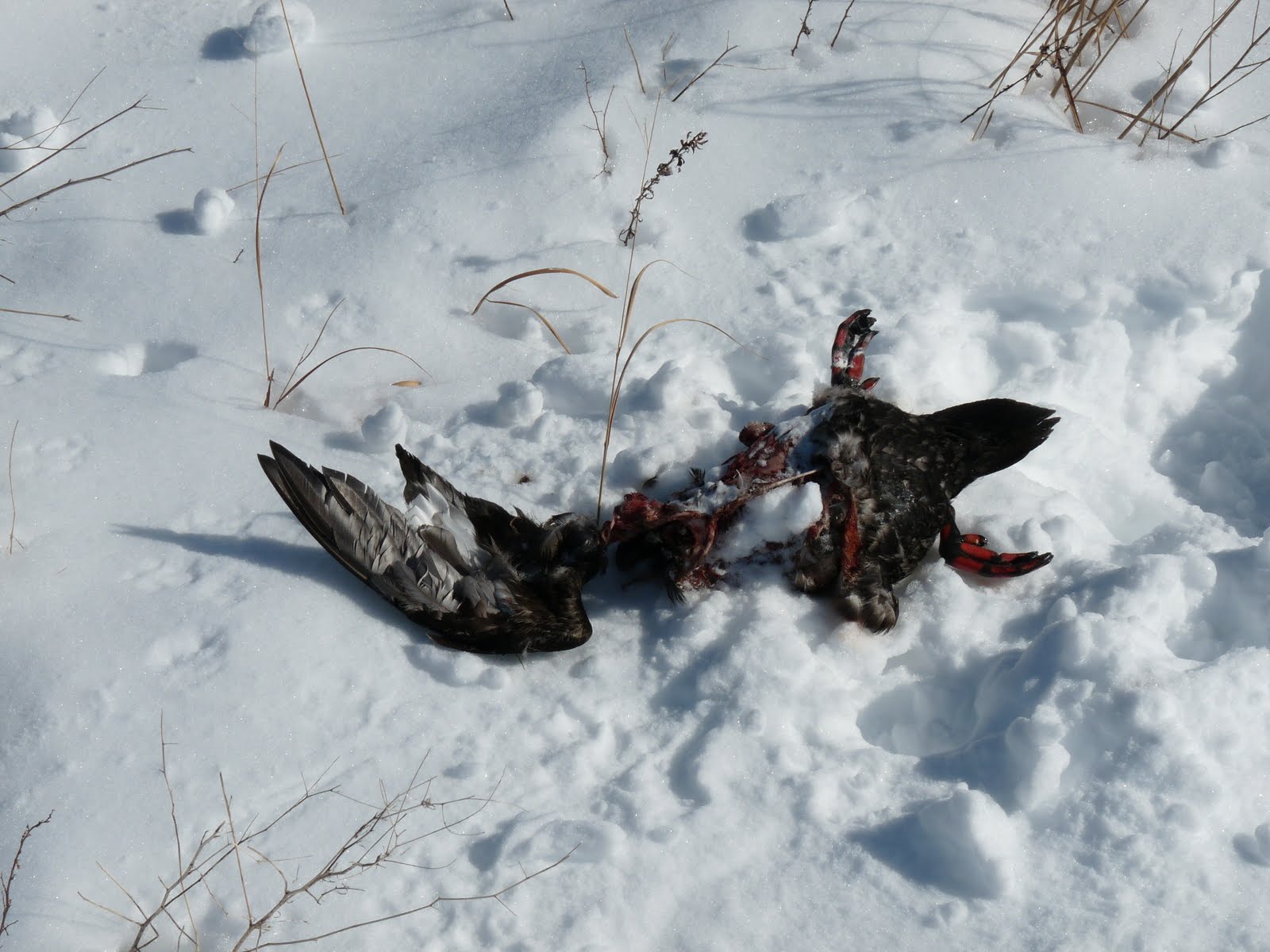
Dead White-winged Scoter

That is what it appears to be, at least. On Monday, before yet another winter storm, I wandered around the coastal grasslands Stratford Point after one of our typical waterfowl surveys. Wandering is not quite the right wrong for it. Since we have feet of snow on the ground, the area is only passable with snowshoes. I wear mine every day and can survey the area on our mowed paths with relative ease. However, the thick area of grasslands was difficult to traverse even with special equipment. I sunk straight through the snow up to my waist. Nevertheless, before I made my way out I discovered a carcass that appeared to be a White-winged Scoter. The large photo of the devoured duck is below - if you have a weak stomach do not click on it.


It was not far beyond our beach. How did it get there? That is a very good question, and one we cannot answer with absolute certainty. One theory was hunting, but I do not believe it was shot by hunters and washed ashore. It could not have been where it was without help, but there were no drag marks on the snow, so it was not brought off the beach by mammals after washing up. Hunting season also ended before the previous storm (it is hard to keep track, trust me on this one) and this was quite obviously on top of the all of the snow. It looked like it had been dropped from the air.

Twan agreed by saying that there was not any indication of scavenging or feeding in the snow surrounding the carcass, at least yet, but that clearly all the "good" parts had been consumed. He also made a particularly interesting observation, saying that there were no broken or smashed bones in the sternum area, which indicates that something without teeth was to blame. So that brings us to raptors...which one? Peregrine Falcon would be the most obvious choice, even with such a sizable prey. They are frequently seen in the area year-round, and as you can see in my last blog entry, a pair has been hanging out at nearby Long Beach during this harsh winter. They are listed as a predator for scoter along with Bald Eagles in the Birds of North America Online. Only exceptionally rarely are Bald Eagles seen at the mouth of the Housatonic River despite the fact they are frequently seen mere miles further up it.

The best guess then seems to be a Peregrine Falcon taking a sick or injured White-winged Scoter around Stratford Point then dropping the heavy kill there to eat in a quieter place. Even though they hunt for small mammals, I have seen Northern Harriers eat freshly killed ducks and geese when they are frozen in winter in Stratford. One or two of the many we get at Stratford Point in winter may have helped to finish off this carcass.


Photo © Scott Kruitbosch

Tuesday, February 1, 2011

New Connecticut State of the Birds report presented by Milan Bull

Milan Bull to address Connecticut Audubon Society’s Connecticut State of the Birds 2011 Report

When: Saturday, February 5, 2011 at 10:00 a.m.

Where: Birdcraft Museum, 314 Unquowa Road, Fairfield, CT 06824

Who: Milan Bull, CAS Senior Director of Science and Conservation & report co-editor

Event: Release of Connecticut State of the Birds 2011 report.

Connecticut Audubon Society’s Connecticut State of the Birds Report, 2011 reveals new and startling information about our forests and the birds that depend on them. Did you know that for the first time in over 200 years our forest resources are declining permanently? Fragmentation and parcelization are reducing our forests into smaller and smaller blocks that can no longer support productive populations of forest-dependent birds. Wood Thrushes, for example, require over 400 contiguous acres of unfragmented forest in order to reproduce productively.

Unlike the past changes in our forests, when they have been converted to agricultural and wood product use, then regrown when abandoned, our forests are now disappearing due to “hard development”, highways, residential and commercial development that permanently destroy forests that may never return.

Find out what Connecticut Audubon Society is doing to help plan a vision that will conserve and protect our important forest resources while maintaining and expanding the economic and natural resources our forests can provide now and into the future.

Free to Connecticut Audubon Society Members and $5 for non-members. To register or for more information call 203-259-6305 ext. 109.

Visit Connecticut Audubon Society’s website at www.ctaudubon.org for a complete listing of programs and special events.