Sunday, January 22, 2012

Name that bird answer

So did you have any luck naming that bird? I heard a bunch of guesses, in person, on Twitter, via email, but not many correct answers. It is a tough one, especially at that distance. By far the most common response was some type of sparrow, such as Savannah or Vesper. Here is the same photo again...


Followed by a larger version of it...
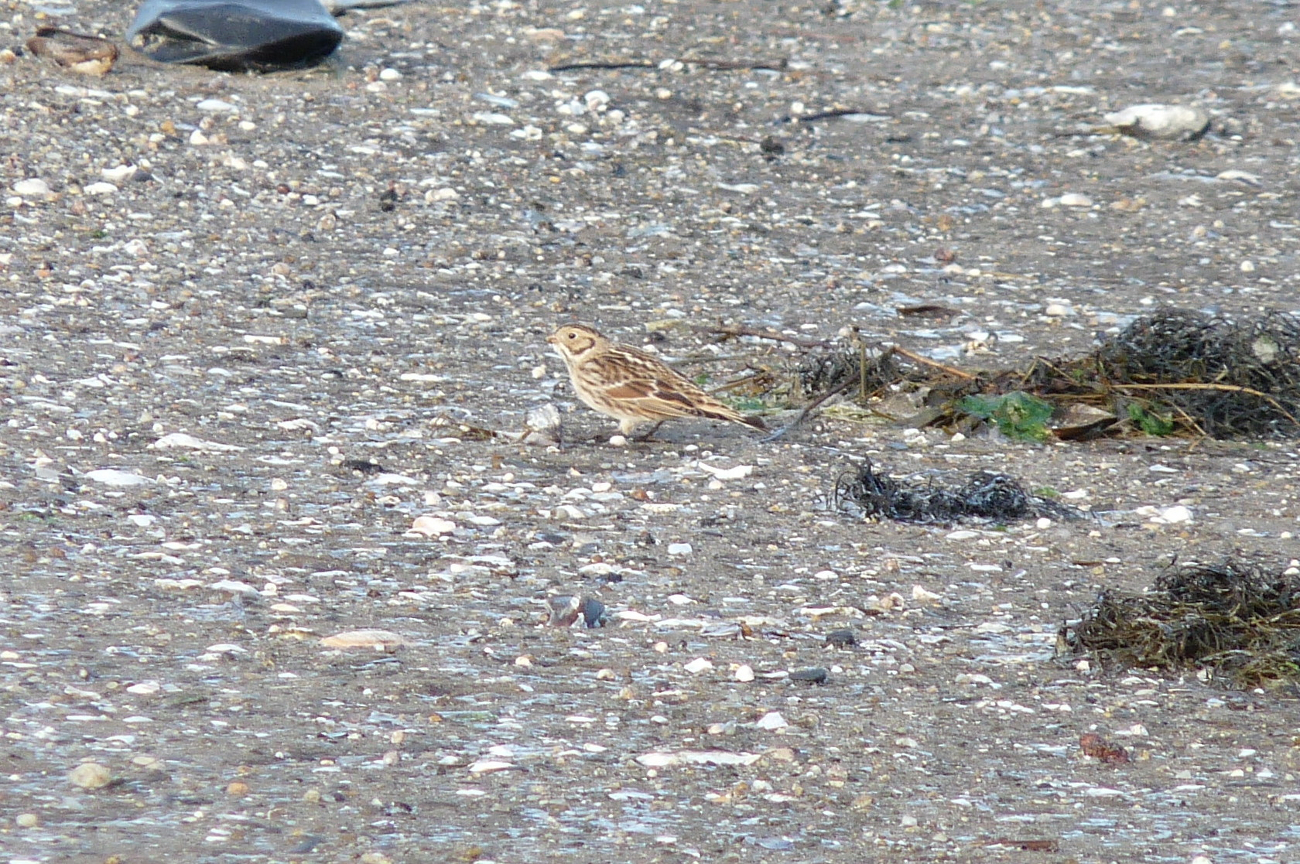

Any thoughts now? Keep in mind this bird is on a beach and it was in the winter, thus you are seeing non-breeding plumage. This is actually the only realistic way you would see this bird in Connecticut since it does not nest here.

Here are better shots of the same individual as it fed.


Do you have it now? It is a Lapland Longspur. They are very difficult to spot in Connecticut sometimes, this winter being one of those times. With that said, one or two are seen usually at least a few times on Long Beach or Pleasure Beach in Stratford and Bridgeport, respectively, each winter season. Seaside Park in Bridgeport is another good spot, as is Short Beach in Stratford, where I saw a lone individual a couple weeks ago. The bird pictured above was on Long Beach on January 5, 2010.

The best way to find them, aside from walking through coastal dunes on a frequent basis, are to seek out the much more obvious flocks of Snow Buntings and Horned Larks, as they will often associate with them, even if only loosely. It might be an even easier time to pick them out right now since coastal Connecticut was buried in several inches of snow yesterday. Always watch any part of the uncovered beach or nearby areas where grass has been ripped up along with plowed snow for a variety of good birds.


Scott Kruitbosch
Conservation Technician

Thursday, January 19, 2012

Name that bird

Here's another photo quiz for all of you busy January "listers" and casual conservationists - name that bird!


Even though I have done essentially no birding outside of work-required time in the field, it is on my January list. It would likely be found in open areas similar to the photo. It may be alone, as it is here in this photo, or it may not. This is the sort of view you might get through a scope or some strong binoculars.

It is not much to go from, but I have faith in the skills of our readers. I'll put the answer up in a few days.


Scott Kruitbosch
Conservation Technician

Tuesday, January 17, 2012

Citizen science and the road less traveled

Birding can be of great assistance to conservation when the birder is a responsible and conscientious observer. This includes carefully recording all of the birds they see at every location they visit, the approximate distance they traveled, the time they take, and at least relatively accurate numbers of the birds of each species they identify. These types of citizen science surveys can enhance the more exhaustive, extensive, and detailed work done by organizations like Connecticut Audubon Society across the state. Of course, this information cannot help if it is not properly disseminated and examined. If these detailed notes are sitting in a book in an attic somewhere, it will not help conservation because we will never know about it.

Do you know of or possess such data you would like to share with us? We always appreciate it, whether it is 100 years old or from 2011, and it helps the birds of Connecticut and our natural world immensely. The best way for you to share that with us would be entering it yourself into eBird.org, but if you cannot do so, we can discuss other options. All of this came to mind after we received a wonderful box of journals full of carefully taken notes from a long-time Connecticut birder. It is a glimpse into a state much unlike our own in the current day.

In a somewhat similar citizen science birding survey sort of topic, I wanted to mention this eBird article: http://ebird.org/content/ebird/news/data_gaps_Jan_2012

Team eBird had a wonderful idea and filled in a map for every state at the county level with eBird data density levels to see how many checklists are submitted. It is a quick and easy way to see what areas are heavily birded and which are not. Very populated areas are well covered and, unlike parts of the Great Plains where there is little or no data whatsoever, Connecticut is no exception, as you can see in these maps of each state.

With that said, Windham County needs some help! If you are a birder in the area or simply want a good excuse to get out into the field, take a trip to the northeast part of the state. My suggestion would be to visit our Grassland Bird Conservation Center in Pomfret and its 700-acre Bafflin Sanctuary. Twan and I have been working on some of the data for it recently, and I noticed our total there went over 200 bird species already with limited survey efforts. It has some incredible birds that are often uncommon or rare elsewhere in the state. Please go discover them, tell us about your trip, and share your data with us on the Center's site on eBird!


Scott Kruitbosch
Conservation Technician

Friday, January 13, 2012

Bird Questions


One thing I didn’t quite realize when I started working for Connecticut Audubon Society in December is that when ordinary folks encounter a bird they don’t recognize or think is unusual or suspect is in the wrong place at the wrong time, they call or email the Audubon Society.
Another thing I didn’t realize is that it would be my job to respond. Not that I'm complaining. It's been kind of fun.

There was the day, for example, when I answered my phone at Connecticut Audubon’s state headquarters and a nice sounding gentleman wanted to know what was the biggest bird you would expect to see in Fairfield -- because he was sure he just saw it.

We talked it over and came to the conclusion that he had probably seen a great blue heron.


Or another day when a man called and wanted help identifying an owl. I asked why. Because there’s one sitting on the window shutter of my house, he said. I asked where that was.

Whitney Avenue in New Haven. It’s been here about a week, he said. It flies away at night and sits on the shutter during the day. It’s about a foot and a half tall, he said.

All of that seemed unlikely but not impossible (I guess), so I asked him to email me a photo. Unfortunately I never heard from him again.

 
This photo (at left) arrived in an email from a woman who lives in Lyme. The only words were in the subject line: “Strange junco?”

Nope. Brown-headed cowbird.

“You’re right,” she said. “I never thought of that. I’ve never seen one in the winter before, much less a lone wolf.”

A gentleman from Westport emailed: “There has been a flock of migrating birds at Compo Beach that I have been unable to identify. They are about half the size or smaller than our Canada Geese, have relatively long black necks and heads with a white ring on their neck about a third down from their head, white rumps, grey sides, and fly in a flock - not a V. I can't find anything like them in the books I've looked at. Can you help?”

I suggested they might be brant, and sent him a link to a page on the Cornell Ornithology Lab’s website. He responded:

"Thank you very much!!!! None of the books I looked at were any help other than finding that there were a range of Canada Geese sizes.
"

And finally this, which accompanied the photo above: “I took this picture of what I think is a Albino Chickadee in Coventry CT on 1-8-2012. I am not sure if this bird is uncommon in Connecticut or not. I have not seen one in the 45 years I have lived here.”


I forwarded the email to our bird experts and ... it turns out the gentleman from Coventry was just about right. It’s a leucistic chickadee, technically, rather than an albino, but close enough.


Got a bird question or identification problem? Let us know. We’ll try to help.


Tom Andersen
Director of Communications and Community Outreach

Rare birds in the water

Many Connecticut birders are starting their 2012 by taking ferry crossings of Long Island Sound from New London to Orient Point to see sometimes dozens of Razorbills, a few Black-legged Kittiwake, and even a Common Murre! One has been seen repeatedly in Connecticut waters, representing the second...third...fourth? and so on...Connecticut record(s). It has yet to be sorted out, though several were seen in total on a recent trip in both Connecticut and New York waters.

It is out of season, but this made me think of a short local trip taken by our Senior Director of Science and Conservation Milan Bull in late September as he took his skiff through the Wheeler Marsh at the CAS Coastal Center at Milford Point. He found some fantastic birds in only a couple of hours, in terms of both species and numbers. It is already known as one of the best places in the state for birds and birding, but watching from our tower or down on the beach often doesn't even begin to show how wonderful the marsh is.

Here are some of his notable birds:
Green-winged Teal  42
American Bittern  1
Least Bittern  1
Great Blue Heron  5
Great Egret  7
Black-crowned Night-Heron  3
Yellow-crowned Night-Heron  2
Northern Harrier  1
Red-tailed Hawk  1
Peregrine Falcon  1
Clapper Rail  3
Sora  60
Marsh Wren  32
Saltmarsh Sparrow  15
Bobolink  25


Even Connecticut experts can be happy with seeing one Sora a year, forget 60+ on one day! He thought there were likely many more. The same can be said for a Least Bittern, and the great views of an American Bittern he was able to get. 32 Marsh Wren is also a ridiculous total. I wonder what is left out there right now in this warm winter. I hope all of you remember this for next season and join the Coastal Center staff for a canoe trip through the marsh. It will be a pleasant thought as arctic air settles in to Connecticut this weekend.


Scott Kruitbosch
Conservation Technician

Tuesday, January 10, 2012

Environmental Issues Seminars Open to Public at Three Rivers Community College

Christina Levere of Three Rivers Community College in Norwich asked if I would pass along information on free environmental seminars they are offering. Since they are no cost and the list of speakers and topics includes some names and information that may be of interest to many of you we decided we would pass it along.

===============

NORWICH, Conn.—Three Rivers Community College is offering a series of environmental issues seminars, which may be taken for credit (as part of a paid program) or at no cost for personal enrichment. The seminars run from 6 p.m. - 7:45 p.m. and include an impressive slate of topical experts. The seminars will be held on the Three Rivers campus in room C101.

For more information or to register contact TRCC Professor Diba Khan-Bureau at 860-885-2383 or email dkhan-bureau@trcc.commnet.edu.


1.  Jan. 25th – William Leahy, Eastern Connecticut State University: “Electric vehicles and their potential contribution to a sustainable environment and economy”
2.  Feb. 1st  – Thomas Worthley, UConn Extension Forestry: “Forest ecosystem services”
3.  Feb. 8th  – Dr. David Bingham, President, Salem Land Trust: “The importance of  environmental stewardship”
4. Feb. 15h – Judy Preston, Tidewater Institute: “A growing problem; coastal water quality challenges from lawns”
5.  Feb. 22th – Elizabeth Timpe, Ecology and Evolutionary Biology PhD Student, UConn: “Global amphibian declines: are we in the midst of the sixth mass extinction?” 
6.  Feb. 29th  – Ed Jutila, State Representative: “Connecticut regulations and the environment”
7.  March 7th – Anthony Irving, former president of the Lyme Land Trust: “Lessons from the Eightmile Wild and scenic river designation”
8.  March 14th – Greg Bugbee, Connecticut Agricultural Experiment Station: “Invasive aquatic plants found in Connecticut lakes”
March 18th – 25th SPRING BREAK – NO CLASSES
9. March 28st  - Brian Murphy, Conn. Department of Environmental Protection: “Stream restoration efforts in eastern Connecticut”
10.  April 4th  – Adam Ney, CBIA, Corporate Sustainability Operating in the Growing Green Economy: “Connecticut’s businesses enhancing their commitment to environmental stewardship, social responsibility, workforce development and ROI”
11. April 11th – Don Gerwick, Gerwick - Mereen Engineering; Tom Wagner, Director Town Planner and Maureen Fitzgerald, Town Planner Inland Wetland Officer for the Town of Waterford: “The Coca-Cola project: environmental planning and stormwater management”
12. April 18th – Dr. Hedley Freake, UConn Nutritional Sciences: “Food, health and the environment”
13. April 25th – Michael Beauchene, Conn. Department of Environmental Protection:
“Rapid bioassessment, benthic macro invertebrates survey and management”
14. May 2nd  - David Stokes, Conn. Department of Environmental Protection, Bureau of Waste Management: “Hazardous waste management and enforcement”
15. May 9th – Hank Gruner, Vice President of Science Center of Conn. & Biodiversity Coordinator, Connecticut Programs, Wildlife Conservation Society: “Construction design challenges to maintain biodiversity”
16. May 16th - Dr. Michael Dietz, UConn Extension office Program Director NEMO: “The Jordan Cove Project: stormwater and low impact design”


===============

Scott Kruitbosch
Conservation Technician

Monday, January 9, 2012

New Year avian presents

2012 has yielded a lot of great bird sightings already including a bunch of warblers like Nashville, Northern Waterthrush, Common Yellowthroat, Palm Warbler, and even a rare Yellow-throated Warbler that has apparently been hanging out at a feeder in Madison since October! There have been Great Egrets seen in numbers all over the coast. A Little Blue Heron is still around, and Nick Bonomo found a Northern Rough-winged Swallow yesterday at the East Shore Park treatment plant. The warm weather is definitely to blame for those birds. On New Year's Day Frank Mantlik found a Snowy Owl, possibly even the same one we had on November 30 based on appearance, at Stratford Point.

Snowy Owl at Stratford Point by Frank Mantlik

Whether or not it was the same bird it did not stick around for long, like the last time, and was not seen since that day. Despite all these lingering birds I mentioned to Frank and Charlie Barnard that I was surprised in all of our Christmas Bird Counts and New Year birding that no one had found an extreme rarity in Connecticut. The very next day Mike O'Leary found a Pink-footed Goose, a third state record, on Somersville Pond in Somers with a few hundred Canada Geese. It has been moving around the general area quite a bit, but once again Frank Mantlik was on it and provided us with these photos.


Pink-footed Goose photos by Frank Mantlik

Congratulations to Mike for the awesome find and thanks to Frank for the great shots of a very rare bird. The warmth, in relative terms, and snow-free days should continue so be on the lookout for more odd overwintering birds and the big passerine rarity I still feel the state is so due for. If you ever have any crazy sightings please email us!


Scott Kruitbosch
Conservation Technician

Photos © Frank Mantlik