Tuesday, January 31, 2012

Q&A with Our Pomfret Sanctuary Manager

Ever wonder what the good parts of the job are for someone who works as a land manager for a conservation organization? And the bad parts?

According to Andy Rzeznikiewicz, the sanctuary manager at our Grassland Bird Conservation Center at Pomfret, the answer is pretty much the same: being outside. The Norwich Bulletin ran a nice Q&A with Andy in today's paper, and here are two of the questions they asked him:
Q: What’s the best part of your job?
A: Being outside and the job changing throughout the seasons. It’s not the same thing every day throughout the year.
Q: What’s the hardest part?
A: Probably dealing with the extreme temperatures, when it’s really hot and humid and when it’s really cold and windy. And the ticks and things like that.
You'll learn a couple more things about Andy as well. For one thing, he's a wheat farmer. For another, the Working Lands Alliance recently honored him with the Farmland Preservation Pathfinder Outstanding Individual Award. Congratulations, Andy!

You can read the Q&A here.

And if you're wondering how to pronounce Rzeznikiewicz, it's just like it's spelled.

Tom Andersen
Director of Communications and Community Outreach


Monday, January 30, 2012

Gray Catbirds in January and changing seasons

As I was on my way to Stratford Point today after a morning of field work, I saw a Gray Catbird feeding in the bushes along Oak Bluff Avenue. I discovered it after spotting a bunch of more typical birds in the area (House Sparrows, Northern Cardinals, White-throated Sparrows, Northern Mockingbird) while slowly driving by, stopping for a moment to see if anything else was lurking in this warm patch. This is the road that borders Stratford's Great Meadows Marsh on the east side, and the one many birders and beach goers are familiar with as it leads to Long Beach and Pleasure Beach.


It was cooperative for only a moment before dashing back into brush far from the road and my camera. There's always something awesome about finding a very common bird out of season like this one. This particular Gray Catbird has been living the good life in Connecticut as the winter of 2011-2012 has consisted of one moderate snowfall that melted with temperatures in the 50s mere days after. From what I have read and heard, it is not alone.

Look at this eBird map of Gray Catbird sightings in only January 2012 across the northeast and nearby regions, whoa! The birds are definitely concentrated on the Atlantic coast, though that is also where the most birders are.


Connecticut has had plenty, and our friend and excellent birder John Marshall told me he has actually seen one in each county already! There are certainly some Gray Catbirds that spend the winter here each year, but this is an abnormally high total. It seems obvious that they and other species, from a variety of warblers to even some Northern Rough-winged Swallows, are able to survive because of the little snow and very warm temperatures. If this were last winter - well, even if approximately the same number attempted to remain here, few would have survived all the way to spring with feet of snow and frigid temperatures being commonplace.

We have had two extreme winter seasons in a row, exactly what climate change should be bringing more of. The birds will have to adapt as best as they can. Overall, we can expect more and more attempting to remain here through the colder months as long-term temperatures will be on the rise, and monitoring weather and climate conditions will become even more important. This rapidly changing reality also means the survey work we complete on a daily basis is even more critical to the application of our best management practices in a variety of habitats across the state.


Scott Kruitbosch
Conservation Technician


Photos © Scott Kruitbosch; map courtesy of eBird.org

Friday, January 27, 2012

Big January 2012

One of the most exciting parts of the New Year for birders is starting a new list of species seen for the upcoming 12 months. However, some people take this up a level by participating in the Big January competition, a friendly and fun game to see who can spot the most species in the month. In the past, this was essentially left to each person to complete on their own, though in 2012 we have internet list servs, eBird, cell phones, and so many other ways to keep in touch and spread bird sightings around. This means average total is going up each year, and with a warm season like this one, I am guessing there may be some never before seen species in January in Connecticut.

This competition is not limited to a small group of elite birders - anyone can join in! Our friend Frank Mantlik usually moderates the event, but as he will be unable to this year, I have taken up the duties. Check out the 2011 results that we posted in the blog last year here.

If you have not heard about this, here are the rules as you may qualify even without knowing about it:
  • To qualify, one needs to have a minimum of 90 species for the month within
    CT.
  • All species seen/heard need to have been counted on public property, your own
    property, or private property with permission.
  • Report your species list in the same order as the COA ARCC Official CT List:
    http://www.ctbirding.org/ct_checklist.htm
  • Deadline for submission is Saturday, Feb. 4 at 10 pm. Send them to me here:
    skruitbosch@ctaudubon.org
  • Digital photos you have taken, especially of rare species, are welcome.
    Note that smaller photo file size makes for easier/quicker emailing. Credit will be
    given on any photos used in the summary report.
  • Since this event is based on the honor system, please make every effort to be
    honest and certain of your identifications.
  • Provide the date and location for the first time each species was identified
    (optional, but encouraged).

I would also encourage everyone to think of conservation when birding this year. Instead of "chasing" down rare birds across the state every weekend perhaps you should see how many you could find in your own town, or at a given sanctuary or two. I have participated in some exceptionally exciting town competitions. You'll find a bird or two you never expected, a new patch to explore, and feel better for helping the environment and your wallet. Whenever I spend $40+ at the pump to fill up the car I think of how even donating the money saved from one tank a year from the thousands upon thousands of nature-loving Connecticut residents could help conservation in our state all while helping not pollute just a little more.

Remember, if you're participating in the Big January competition please send me your results by 10 p.m on February 4. If you do not qualify at 90 or more species but have a great sighting or wonderful photo please feel free to pass it along to me. Thank you and good luck!


Scott Kruitbosch
Conservation Technician

Wednesday, January 25, 2012

Help conserve threatened beach nesting birds in Connecticut

Connecticut's shoreline provides critical habitat for the federally threatened Piping Plover. You can help us conserve this threatened beach-nesting species:

  • Do you have an interest in wildlife?
  • Do you enjoy walking along the beaches of Long Island Sound?
  • Can you spare at least two hours a month to help threatened birds in our state?

Please consider volunteering as a Piping Plover monitor for the U.S. Fish and Wildlife Service!

For the last several years the U.S. Fish and Wildlife Service, Connecticut Department of Energy and Environmental Protection, the Connecticut Audubon Society, Audubon Connecticut, The Nature Conservancy and The Friends of Milford Point/Stratford Great Meadows NWR have partnered together to monitor beaches between West Haven and Stratford for nesting Piping Plovers.

These migratory birds return to the Connecticut coast each March from their wintering grounds on the Gulf Coast and stay here up to five months to nest and raise their young.  Located on the beach, their nests are extremely susceptible to human disturbance, destruction by predators, and tidal wash outs. Volunteer monitors make a big difference, enhancing the survival and productivity of plovers and terns in our state.

As a monitors, you will observe and record data about various beach nesting birds and their chicks at one of four locations: Milford Point near the Connecticut Audubon Coastal Center; Silver Sands State Park in Milford; Long Beach in Stratford; and Sandy Point in West Haven. The primary duties involve assisting the USFWS with observation and data collection about nesting Piping Plovers, and helping to educate the public about these species. Volunteers work 2-hour shifts from April until the end of the breeding season (usually in August) and must donate a minimum of 2 hours per month.


If you are interested, please attend the training and orientation session held Saturday, March 10, 2012 from 9 a.m. to 12 p.m. at the Connecticut Audubon Coastal Center at Milford Point.


The session will include piping plover natural history, the state of plovers in Connecticut, volunteer organization and logistics, reporting responsibilities, and beach training with simulated plovers and eggs.

For more information on the training session, directions to the Connecticut Audubon Coastal Center, or to make reservations, please call USFWS Ranger Shaun Roche at (860) 399-2513 or email Shaun_Roche@fws.gov

Thank you!

Audubon Alliance for Coastal Waterbird Conservation, Audubon Connecticut and the Connecticut Audubon Society partnering to improve conditions for coastal waterbirds in Connecticut.

Tuesday, January 24, 2012

Red-shouldered Hawks at a Fairfield High School

It’s only January, barely the start of breeding season, but a pair of territorial hawks have been strafing students at Fairfield Ludlowe High in recent days, raising the level of angst among students and teachers. Last week one of the hawks reportedly landed on a student’s head; this week one swooped down and grazed another student’s head.

Police were called to the scene (although to do what is unclear). The Connecticut Post wrote about it twice, the second time catching the attention of the New York City media. Today, WCBS 880, Fox 5 News, and WCBS Channel 2 news were all at the school.

Coincidentally our Birdcraft Museum and Sanctuary is just up Unquowa Road from the school, and the reporters made the most of it, interviewing Milan Bull, our senior director of science and conservation.

Milan’s opinion? It’s very unusual behavior (the birds, that is, not the media).

“It’s rare that red-tailed hawks become aggressive on their territory, but it does happen. This particular pair became aggressive last year defending a nest that was right next to the high school. And now, although it’s early in the nesting season, they’re setting up their territory and are becoming aggressive towards people who are coming close to the nest.

“They’re trying to send a warning, but they will make contact. It’s a brief contact, but it’s a very surprising contact when you get hit in the back of the head with a couple pounds of red-tailed hawk.”

Interestingly, when Channel 2’s Mark Morgan showed up, he asked if we were sure the hawks were red-tails, as was reported. Nobody at Connecticut Audubon had actually seen them, so all we knew was what we were told.

Mark said he himself is a birder and that these hawks -- which he got a good look at -- had banded tails, rather than red tails, and that he was pretty sure they were red-shouldered hawks. He described them to Milan, who agreed that from Mark’s description they seemed like red-shouldered hawks rather than red-tails: Buteo lineatus rather than Buteo jamaicensis.

But his main opinion didn’t change: It was still very unusual behavior.

State environmental officials may try to remove the nest, assuming there is a nest and assuming they can find it. Milan’s advice for people in the area: stay alert and, if you see a hawk swooping towards you, put your hands in the air.

Here’s a link to the WCBS story, with audio; and here’s the latest Connecticut Post story.

Tom Andersen
Director of Communications and Community Outreach

Monday, January 23, 2012

February Stratford Point bird walk

Connecticut Audubon Society Conservation Biologist Twan Leenders and Conservation Technician Scott Kruitbosch will lead a public bird walk at Stratford Point on February 21 from 11 a.m. to 1 p.m., with an inclement weather date of February 28, same place and time. It will be a great chance to find more wintering water birds, from loons to scoters to gulls and grebes and much more. The coastal grasslands and dune habitat often attracts Snow Buntings, Horned Larks, and a variety a sparrows. It is also a good time of year to find irruptive raptors like Short-eared Owl or Rough-legged Hawk.

We will discuss the exciting habitat management and conservation projects that will be taking place at Stratford Point late this winter and into the summer. The walk will be free and we suggest bringing binoculars and a spotting scope, if you have one. Make sure to dress for the season! It is usually safe to assume that this exposed coastal spot is windier and colder than much of the state. Please meet in the visitor parking lot by the buildings. Stratford Point is located at 1207 Prospect Drive, Stratford. For more information, contact Scott Kruitbosch: skruitbosch@ctaudubon.org


Scott Kruitbosch
Conservation Technician

Sunday, January 22, 2012

Name that bird answer

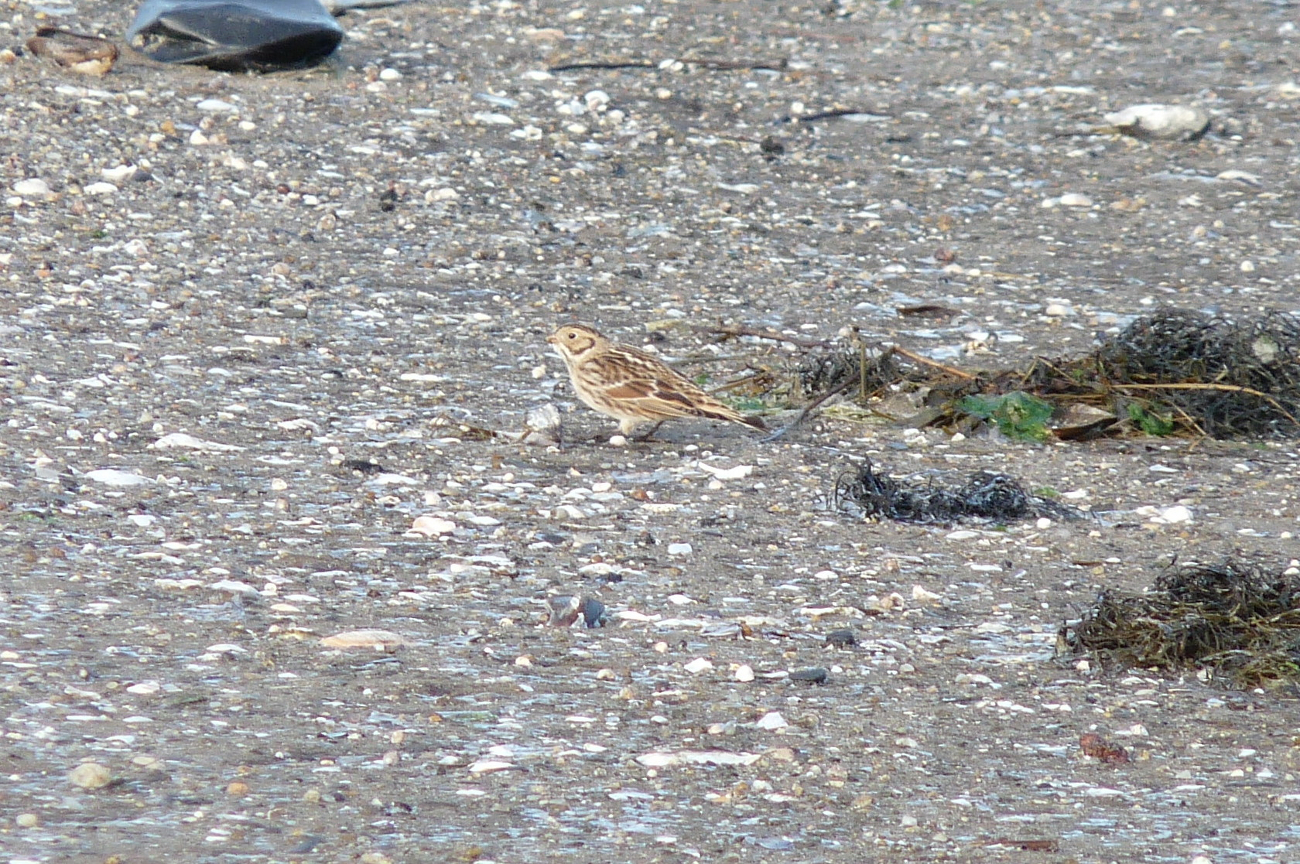
So did you have any luck naming that bird? I heard a bunch of guesses, in person, on Twitter, via email, but not many correct answers. It is a tough one, especially at that distance. By far the most common response was some type of sparrow, such as Savannah or Vesper. Here is the same photo again...


Followed by a larger version of it...


Any thoughts now? Keep in mind this bird is on a beach and it was in the winter, thus you are seeing non-breeding plumage. This is actually the only realistic way you would see this bird in Connecticut since it does not nest here.

Here are better shots of the same individual as it fed.


Do you have it now? It is a Lapland Longspur. They are very difficult to spot in Connecticut sometimes, this winter being one of those times. With that said, one or two are seen usually at least a few times on Long Beach or Pleasure Beach in Stratford and Bridgeport, respectively, each winter season. Seaside Park in Bridgeport is another good spot, as is Short Beach in Stratford, where I saw a lone individual a couple weeks ago. The bird pictured above was on Long Beach on January 5, 2010.

The best way to find them, aside from walking through coastal dunes on a frequent basis, are to seek out the much more obvious flocks of Snow Buntings and Horned Larks, as they will often associate with them, even if only loosely. It might be an even easier time to pick them out right now since coastal Connecticut was buried in several inches of snow yesterday. Always watch any part of the uncovered beach or nearby areas where grass has been ripped up along with plowed snow for a variety of good birds.


Scott Kruitbosch
Conservation Technician