This year's fireworks displays are coming up soon across Connecticut and with them comes an increased need to help the Audubon Alliance for Coastal Waterbirds to protect coastal waterbirds at busy beach sites in the middle of nesting season. We will be looking for help at
Milford Point on the evening of July 3 during the Stratford display. We
will also be looking for help at Sandy/Morse Points in West Haven on July 3 and July 4
for the West Haven and New Haven displays, respectively. Please email
us at ctwaterbirds@gmail.com if you would like to join AAfCW and CT DEEP
staff in monitoring and outreach at these locations from around 9PM on
those nights until the shows have concluded.
There will also be a few dates we will be looking for additional volunteers later in July in eastern parts of Connecticut. I should note that a week ago Sean Graesser and I completed a detailed and methodical official survey of the sand spit at Milford Point in order to tally all of the Least Terns present and how many nests were going. There were at least 700 birds with about 325 pairs/nests and a couple dozen more courting. Since then the first eggs have hatched and there are likely more nests. If you visit Milford Point please remain on Connecticut Audubon Society Coastal Center property and try not to go past the platform if you can. We really want to voluntarily have everyone give all these hundreds of birds (plus multiple families of Piping Plovers with over 20 chicks of various ages) as much space as possible so that they are successful. This could be a big success if we can limit traffic and disturbances and continue educating the public on why these birds are both imperiled and important. If you want to become a coastal waterbirds monitor for AAfCW please email ctwaterbirds@gmail.com.
Scott Kruitbosch
Conservation Technician

Saturday, June 29, 2013


Thursday, June 27, 2013
Odonates are popping up
Dragonfly and damselfly populations have been exploding during the warm and wet month of June. Get out there now if you want to see the peak of diversity in Connecticut. Even at places like Stratford Point you can find some migrants like the Painted Skimmer...
.JPG)
Or the Black Saddlebags...
.JPG)
Numbers will be on the rise for a while yet and after the next week of wet and unsettled weather we should have a bonanza of them in every expected habitat.
Scott Kruitbosch
Conservation Technician
Photos by Scott Kruitbosch © Connecticut Audubon Society and not to be reproduced without explicit CAS permission
.JPG)
Or the Black Saddlebags...
.JPG)
Numbers will be on the rise for a while yet and after the next week of wet and unsettled weather we should have a bonanza of them in every expected habitat.
Scott Kruitbosch
Conservation Technician
Photos by Scott Kruitbosch © Connecticut Audubon Society and not to be reproduced without explicit CAS permission
Tuesday, June 25, 2013
Rain means rainbows
We have had a heck of a lot of water fall from the sky in the last couple of weeks as I mentioned in this post. From the remains of a tropical cyclone to anomalous lows moving in from the west to convective thunderstorms it has been a nonstop parade of rainmakers. I wanted to share some photos of some of the weather I saw at Stratford Point while attempting to conduct waterfowl surveys without getting too wet or being threatened by lightning.
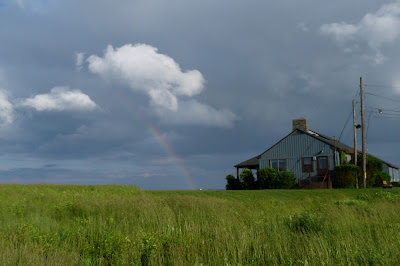
You can see a nice rainbow in this shot looking to the south.
This is looking east into Long Island Sound as a rainbow attempts to brighten - you can even see what's at the end! Here's a hint - more water.

Lastly this thunderstorm was coming in from the north near sunset creating a lovely shade in the sky.

How much more can we get? In our state of extremes I do not know. Let's hope that one tropical event was it for the entire year.
You can see a nice rainbow in this shot looking to the south.

This is looking east into Long Island Sound as a rainbow attempts to brighten - you can even see what's at the end! Here's a hint - more water.

Lastly this thunderstorm was coming in from the north near sunset creating a lovely shade in the sky.

How much more can we get? In our state of extremes I do not know. Let's hope that one tropical event was it for the entire year.
Scott Kruitbosch
Conservation Technician
Photos by Scott Kruitbosch © Connecticut Audubon Society and not to be reproduced without explicit CAS permission
Sunday, June 23, 2013
Deer tick nymph
I was very thankful to observe a little bit
of...something...on my dog's face about a week ago. I went up to him and let
this tiny speck of a parasite crawl on to my finger.


That deer tick nymph would have gone unnoticed on 98% of his
body as he's a Shetland Sheepdog. I am relatively certain that 99% of us would
have never known it was on us, either. This makes me wonder how many I miss on
myself or on him. All he had done was go outside in the yard at home with me
watching his every step. Please be careful where you walk, run, hike, play, or
whatever else, and please take the time to check yourself for even nearly
microscopic ticks like this one at this time of year. This is why Connecticut
has to focus on restoring the balance of wildlife in its woodlands while
removing non-native and/or invasive plants as high levels of certain mammal
species combined with plants ticks favor all help to maintain these
ridiculously high populations in our own backyards.
Scott Kruitbosch
Conservation Technician
Conservation Technician
Photo by Scott Kruitbosch © Connecticut Audubon Society and not to be reproduced without explicit CAS permission
Friday, June 21, 2013
Parents hard at work
I have not seen the fox family all together for a while now. They must be well on their way to advanced learning at this point of the development. They seem to be staying primarily nocturnal and crepuscular (appearing at night or near dawn or sunset, respectively). I did see one parent running around in the rain recently and snapped this shot.

It was much more concerned about fishermen walking on the property than me standing by the main building. Maybe they have gotten to know us. Or perhaps they are more interested in what the fishermen may leave behind in the form of fresh free meals. I have noticed the local squirrel population, low as it was, has taken quite a hit. The upper limits of the grasslands at Stratford Point were shielded from the tidal surges of Hurricane Sandy and allowed mammals to survive. This did not happen along much of the coastline and many perished during the storm leaving populations lower than usual. The additional blast from the Blizzard of 2013 also dropped populations further as those that were not prepared for over 30 or 36 inches of snow in a little over 24 hours did not survive. The times are tough in many areas for birds and mammal predators that rely on these small mammal populations but they will rebound very quickly.
Scott Kruitbosch
Conservation Technician
Photo by Scott Kruitbosch © Connecticut Audubon Society and not to be reproduced without explicit CAS permission

It was much more concerned about fishermen walking on the property than me standing by the main building. Maybe they have gotten to know us. Or perhaps they are more interested in what the fishermen may leave behind in the form of fresh free meals. I have noticed the local squirrel population, low as it was, has taken quite a hit. The upper limits of the grasslands at Stratford Point were shielded from the tidal surges of Hurricane Sandy and allowed mammals to survive. This did not happen along much of the coastline and many perished during the storm leaving populations lower than usual. The additional blast from the Blizzard of 2013 also dropped populations further as those that were not prepared for over 30 or 36 inches of snow in a little over 24 hours did not survive. The times are tough in many areas for birds and mammal predators that rely on these small mammal populations but they will rebound very quickly.
Scott Kruitbosch
Conservation Technician
Photo by Scott Kruitbosch © Connecticut Audubon Society and not to be reproduced without explicit CAS permission
Tuesday, June 18, 2013
From drought to record rainfall
We had been in the midst of a drought after a dry spring season, but that ended quickly, didn't it? Bear in mind when I say "spring" I am referring to meteorological spring which runs from March 1 through May 31, and if you were living near the Bridgeport area it was the fifth driest spring on record out of 49 years of observations.
Take a look at this cool graphic provided by the National Weather Service in Upton, New York of local climate stations. This was through only June 13!

It was right after this daunting anomalous low had passed through the area to add to the total.

We have had several rain events since then, but I don't think we can touch Bridgeport's insanely high monthly record. As of June 18, with more rain to come today, the "Bridgeport" station in Stratford's Sikorsky Airport has received 8.62 inches of rain in June with probably more to come even today. The Hartford area station at Bradley Airport is extraordinarily close to the shore at 8.63 inches, a strong 5.88 inches above normal. While we can't be sure what will happen beyond a couple of weeks with any sort of certainty in terms of actualized weather I can be sure it will be a strong year for insects unless we immediately go back into drought and extreme heat dries us out for a prolonged period.
Scott Kruitbosch
Conservation Technician
Take a look at this cool graphic provided by the National Weather Service in Upton, New York of local climate stations. This was through only June 13!

It was right after this daunting anomalous low had passed through the area to add to the total.

We have had several rain events since then, but I don't think we can touch Bridgeport's insanely high monthly record. As of June 18, with more rain to come today, the "Bridgeport" station in Stratford's Sikorsky Airport has received 8.62 inches of rain in June with probably more to come even today. The Hartford area station at Bradley Airport is extraordinarily close to the shore at 8.63 inches, a strong 5.88 inches above normal. While we can't be sure what will happen beyond a couple of weeks with any sort of certainty in terms of actualized weather I can be sure it will be a strong year for insects unless we immediately go back into drought and extreme heat dries us out for a prolonged period.
Scott Kruitbosch
Conservation Technician
Sunday, June 16, 2013
The answer to the shadow
By that I mean the answer to what this shadow of a bird is. Take a look at it again here.

What can you tell about the size? Relative to the vegetation surrounding it the bird seems relatively small. It is holding its wings out a little and it has a somewhat long tail with some feathers worn. This bird has seen quite a tiring migration. It has a small short bill and round average-sized head. Even knowing what it is this profile strikes me as almost prototypical for a little songbird.
Still, the dimensions and positioning help betray the fact this is an insect eater. That tiny bill is somewhat pointed and definitely not meant for eating anything too hard. You can probably tell this is a warbler - but what kind? That would be quite a task, but do you remember what I said about cheating in the first post with this photo? I meant this "enlightening" look as we lower the quality of the image while markedly raising our ability to identify the bird...

That is a Canada Warbler that spent the morning singing and foraging around my yard. I hope it is at its breeding grounds so that it can relax, start a family, and then finally molt before the trip back.
Scott Kruitbosch
Conservation Technician

What can you tell about the size? Relative to the vegetation surrounding it the bird seems relatively small. It is holding its wings out a little and it has a somewhat long tail with some feathers worn. This bird has seen quite a tiring migration. It has a small short bill and round average-sized head. Even knowing what it is this profile strikes me as almost prototypical for a little songbird.
Still, the dimensions and positioning help betray the fact this is an insect eater. That tiny bill is somewhat pointed and definitely not meant for eating anything too hard. You can probably tell this is a warbler - but what kind? That would be quite a task, but do you remember what I said about cheating in the first post with this photo? I meant this "enlightening" look as we lower the quality of the image while markedly raising our ability to identify the bird...

That is a Canada Warbler that spent the morning singing and foraging around my yard. I hope it is at its breeding grounds so that it can relax, start a family, and then finally molt before the trip back.
Scott Kruitbosch
Conservation Technician
Photos by Scott Kruitbosch © Connecticut Audubon Society and not to be reproduced without explicit CAS permission
Subscribe to:
Posts (Atom)