I mentioned some of the early movement of various bird species only yesterday, but I saw more evidence of it in the last 24 hours. All four typical swallow species - Tree, Barn, Northern Rough-winged, and Bank - have young seemingly everywhere. Cliff will be on the way soon. Some of the local and early nesting warblers, specifically Yellow today, have juveniles now feeding on their own separate from the family. This was also the case for a young House Wren I saw at Stratford Point. The species does not nest on the property. However, some do only a short distance away around residential homes. The individual I saw was far into the property around the Stratford Point buildings. This is where we often find migrants or wanderers, as they fly all the way to the water of the Sound only to backtrack a couple hundred meters to the shrubs surrounding the buildings.

The photo above is of a Bobolink. I found it around the edge of Stratford Point today. It is the first of many migrants that will use the coastal grasslands management area as a stopover site. We often find impressive numbers in both the back field and grasses in front of our main building. This is an early sighting for a returning bird. The beginning is typically about two weeks from now, with most found here in August. Last year we had over 60 on some days. All of these juveniles and wanderers seem ahead of schedule because of the early breeding season. Just as in spring migration, the sun and hormonal changes in birds dictate much of their fall migration. For example, their body has to begin storing fat for the journey south. Nevertheless, it seems likely that at least a percentage of most species, from shorebirds to passerines to (I hope!) raptors, will be traveling early this summer.
There is always a distinct lack of observations in July and August. Please go outside and record your sightings to eBird. You never know what you may find. At the very least keep an eye out for early migrants or the beginning of the hawk movement.
Photo © Scott Kruitbosch
While long overdue, I wanted to specifically thank the Connecticut Ornithological Association and individual donors for the generous financial aid they provided the Connecticut Audubon Society in order to purchase new Purple Martin gourd trees. Twan and I have posted about them before, including when we first installed them. Gourd tree at sunset.
 With the Stratford Lighthouse in the background.
We have had Purple Martin scouts checking them out at Stratford Point. The gourd tree at Milford Point was installed next to the currently populated box-style house. I have to think both will be populated next spring. Under threatening skies.
Thank you to all who contributed! We have many, many, many more wonderful projects to help out the birds at our sanctuaries like this on our minds and always appreciate the aid. I will post about them soon.
Photos 1, 3 © Scott Kruitbosch; photo 2 © Twan Leenders
 The scorching and record-setting heat of the past week has kept nearly everyone indoors. Some of the surveys here this week were conducted in the evening. Even during the hottest moments, I have seen plenty of Spotted Sandpiper flying about, often foraging on the shores during low tide. They seem to be all over the place this year. On Independence Day, I heard a Forster's Tern flying close to shore with some of the Common, the same circumstances as the last sighting of one here. They have such a distinctive call. I also saw a few Least Tern flying around. None of the terns has been juvenile...at least yet. I hope that we will be seeing some at the end of the month at the latest. Another period of very high tides is coming up. Whatever beach they are nesting on the eggs will hopefully have hatched and the young mobile enough to seek higher ground. Speaking of the tides, here are a few photos from high tide this morning.
 Storms and rain falling over Milford, Orange, and points beyond. See the rain?
 Somehow this does not produce rain on Stratford Point.
 A few rumbles of thunder over Long Island Sound.
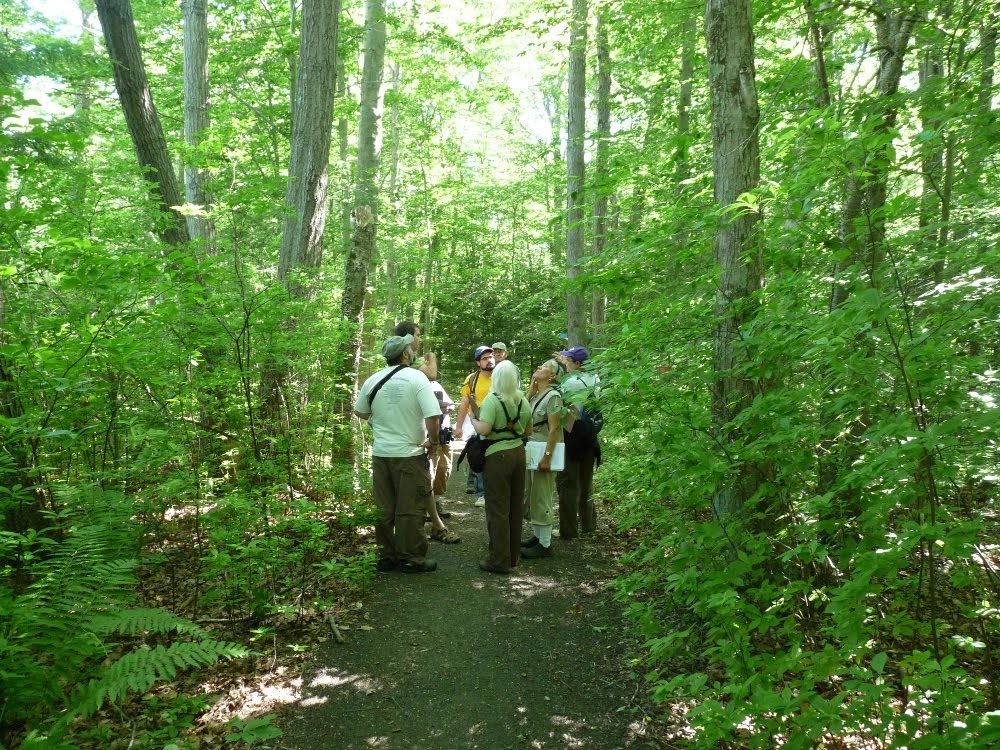
In late June Frank, Twan, and I lead a breeding bird survey training session on CAS' 155-acre Roy and Margot Larsen Wildlife Sanctuary adjacent to our Fairfield center located on 2325 Burr Street, Fairfield. Described here in the 2010 Connecticut State of the Birds report, there is a growing need for volunteers trained to systematically collect the information necessary to best protect our birds and their habitats. We wanted to impart the protocols, techniques, and tips for how to discover and categorize a species as a possible, probable, or confirmed breeder.
Our group started things off right. As we gathered in the parking lot, we had a fledgling Tufted Titmouse in the tree over our heads. It was fed by an adult who was taking seed from the CAS center's feeders. This was a quick breeding confirmation. Listening for begging calls or the voices of young is one of the easier ways to confirm a species as breeding. Fledgling Black-capped Chickadee sing or call with half the effort of an adult, putting out a scratchy and shortened version that can be identified from a far distance.
 In the above photo, the group is watching and recording both House Wren and Tree Swallow going in and out of nest boxes carrying food. Nest boxes not only provide a safe home for the birds, but they can make monitoring breeding even easier, and provide many enjoyable moments. If you have never erected one in your yard, come to one of our centers to purchase some for next season. Our staff can help you decide on what breeding species your yard habitat could support.
Below the group was listening to a Great Crested Flycatcher that we would soon see flying in and out of a nest cavity about 25 feet up in a tree. These can be difficult to locate. When I took the photo Twan was instructing the group that if you can find a male singing at a location more than a week apart the species would be classified as a probable breeder. This is particularly useful in dense forest where you may not be able to see or locate a nest. Ovenbird, a species we heard repeatedly during our walk, have an inconspicuous nest but an easy song to hear and identify that they sing frequently all spring and summer.

On the way out, we stopped at farm pond near the entrance to the 155-acre sanctuary. The turtle on the left is an eastern painted turtle. Twan explained to the group that the turtle on the right was a red-eared slider, an invasive species. They are often released as former pets. If you look closely, you can see the "red ear" that gives the species its name. Releasing former pets into the wild is exceptionally damaging to the local ecosystem. We will have to trap and remove this turtle, placing it in captivity again.Breeding bird survey work is sorely needed across the entire state, especially in Important Bird Areas or other bird sanctuaries. As you may have seen in previous entries, Twan and I have tried to conduct a breeding bird survey at every CAS property or sanctuary this summer. We are about 80% done. Even though we are experienced in the protocol, there is still simply not enough time among all our other work for us to complete it by ourselves, let alone monitor the IBAs or other vital habitat. Please consider volunteering in the future.Photos © Scott Kruitbosch
My goodness, the heat. The temperature during the past and upcoming few days has been nearly all that anyone is talking about. It is impossible to avoid if one wishes to leave an air-conditioned home if they are fortunate enough to have one. Today was the worst, with record high temperatures were tied or broken all across New England and the Mid-Atlantic. Fortunately, it should be the worst day this week, and likely this year. At around 2PM I got a reading of 101.4 in Stratford. The heat index was well into the 112-116 range. Getting to 100 on the coast takes a lot of work.
Days like this humans and birds share the same feeling - that of not wanting to do much of anything. During the brief times I have been outside in the past few days there have not been many birds to hear or see. It was notably quiet (to the ears) today. Very few birds were singing or calling. I heard an American Goldfinch call as it flew over, while a Great Crested Flycatcher yelled out "creeeeeep!" in the woods. The local House Wrens were a bit chatty, likely only because of me. Most of the sightings I had were of birds taking a short, slow, flight to the birdbaths. I did not see any that bathed. They only drank, and quite a bit. A Gray Catbird took an exceptionally long drink before darting back into the shade. House Wren bringing food to nestlings - the young are very vulnerable in extreme heat on days such as this.
This week continued much of last week's bird species at Stratford Point. Common Tern continue passing by, sometimes with fish in mouth. Least Tern have made a couple appearances as well. I have yet to see any young tern. However, juvenile swallow of a few species seem to be cycling around the general area, dispersing from nearby nesting locat ions. Laughing Gulls can be seen now and then flying by. Speaking of birds flying by, I saw a Piping Plover this evening going from west to east, towards Short Beach. It called as it flew and went towards a very busy beach that was full of people for the Stratford fireworks a couple hours later. I took the photo to the left from Stratford Point facing Short Beach at sunset today. The only birds in the water were Mallard and Double-crested Cormorant. One Great Egret and one Snowy Egret were grazing along the beach and shoreline. Gadwall are typically in the water in this area as well, though none were today. Soon there will be many southbound shorebirds feeding along these beaches. We will likely see the first ones during this upcoming week.
The Purple Martin gourds have been somewhat repaired...at least for the time being. Twan was able to hammer it back into place, but we will need to re-cement the entire structure in place. If you did not see the entry, it was pulled up by the hurricane force winds from the tornadic supercell thunderstorm that swept through on June 24. I will make another post about them soon. To the right you can see the view from in front of the main building at Stratford Point. The building is on the right, with the Stratford lighthouse in the distance. It really is Purple Martin paradise. I also wanted to give everyone a rescued Osprey update. On Thursday night, the female was brought from Wildlife in Crisis to the veterinarian for x-rays and heavy metal toxicology screenings. We should know more on her condition and exactly what happened to render her flightless after the holiday weekend. Once again, the mere fact she is alive and relatively functional bodes well for her future. I frequently see healthy Osprey flying around Stratford Point now, sometimes multiple birds. I am sure this is some of the population that lost their nests during the storm, as there are more birds flying about for longer periods than one would expect if they were tending to young.
Photos © Scott Kruitbosch
The following is a CAS press release about a wonderful event that took place at Birdcraft on June 21.
13-year-old Connecticut Audubon Society Volunteer Alex Burdo Wins L.L. Bean “Outdoor Heroes Award” – 1st Youngster Ever To Win!
June 24, 2010 -- Alexander (Alex) Burdo, a 13-year-old resident of Fairfield, an avid birder and an active volunteer with Connecticut Audubon Society, has been named an L.L. Bean “Outdoor Hero.” The announcement was made on Monday, June 21 at Connecticut Audubon Society’s Birdcraft Museum and Sanctuary in Fairfield. Alex received the award from Barbara Noe, Manager of L.L. Bean’s South Windsor store, and J.P. Fischer, L.L. Bean’s Active Department Outdoor Discovery School Manager.
Alex, who is a resident of Fairfield, is the first youngster ever to win the L.L. Bean “Outdoor Heroes” Award. Introduced in 2007, the award is given each year to a select number of individuals who are helping to preserve outdoor spaces and activities for all to enjoy and are encouraging others to do so as well. Nominations are open to any individual who has made a significant contribution to creating, maintaining, teaching about or encouraging the use of recreational space and the species that inhabit it. “This year L.L. Bean received well over 100 nominations,” said Barbara Noe. “And one name rose to the top of the list: Alexander Burdo.”
Alex had no idea that he was receiving an award when he came to Birdcraft on Monday at 10 a.m. with his grandfather, Jim Orrico. Alex thought he was joining Judy Richardson and other CAS volunteers in doing a nesting bird survey in the 6-acre Birdcraft Sanctuary. Instead, and in the presence of his family and CAS staff and volunteers, L.L. Bean’s Barbara Noe and J.P. Fischer presented Alex with an engraved lantern, a $500 L.L. Bean gift card, and a $5,000 check to Connecticut Audubon Society in his honor. “Alexander has set a fabulous example not only for his peers but also for all the adults who have been touched by his commitment to birds and the environment,” said J.P. Fischer. “As the person who nominated you wrote, you are truly extraordinary. You are a hero.”
“Alex Burdo is the kind of young person who inspires us all to do more and to do better,” said Robert Martinez, President of Connecticut Audubon Society. “Our organization is so fortunate to have Alex as a member and a dedicated volunteer. He is such an incredible role model for everyone who meets him.”
J.P. Fischer of L.L. Bean explained that through Alex’s nomination, a wonderful story unfolded, and she read excerpts from the nomination: “In the 19th century Mabel Osgood Wright engaged the talents of her friends with a commitment to social action to establish the Connecticut Audubon Society. Her efforts were a defining example of citizen science: the collaborative effort of people volunteering together as advocates for birds, wildlife and environmental conservation to realize a shared vision. A century later, Alexander Burdo exemplifies Mrs. Wright’s underlying message that every motivated person can make a difference in how the greater community perceives and protects nature.”
Fischer continued, “Alex is a perfect example for other students and novices of how citizen science can be accomplished by anyone of any age.” At the age of 10, Alex had a 3rd grade project about birds. He brought in field guides and binoculars to help his classmates learn about the birds around them. Alex’s journey of engaging others in citizen science had begun! When Alex’s school, Unquowa School, set up the Cornell Lab of Ornithology’s Project Feeder Watch, Alex served as a ‘consultant’ to the faculty coordinating the project. Alex designed posters, created the calendar, posted pictures and assisted with tallying data. He helped younger students identify and count birds and served as a mentor to children new to birding. And Alex’s birding blog enables him to document bird species, their habitats and the conservation concerns they face, and then share this information with others with the tap of a finger.”
“I have had many children come in to help with bird banding in the 20 years that I have been involved,” said Judy Richardson, Chairman of CAS’s Fairfield Regional Board of Governors and a master bird bander. “But Alex is different. Not only does he want to pursue a future in birding, he has already started! His passion bubbles out of him when he reports all the birds he has seen. And he doesn't stop there. He has taken the time to teach anyone who will listen, by helping to establish Cornell’s citizen science Project Feeder Watch at his school, and by sharing his joy of the outdoors with his family and friends. Alex has become a respected young birder and he has the best attribute of good birders, which is a willingness to share. When bird migration is in full flight, I can rely on Alex to give me an enthusiastic report of all the birds that have flown in the previous night. He's a great kid with a great love of birds. Connecticut Audubon Society, and ornithology in general, is lucky to have him.”
Alex, who has been birding since the age of six, also “hooked” his grandfather, Jim Orrico and together they have driven all over the country to go birding. But Alex considers Connecticut Audubon Society’s 6-acre Birdcraft Sanctuary as his favorite sanctuary, and Alex and his grandfather are often here birding or helping the bird banders.
“I was surprised and truly honored to receive such a prestigious award,” Alex said. “But my biggest thrill about the whole thing was being able to give the Connecticut Audubon Society $5,000 from L.L. Bean, money that could really make a difference for the wonderful birds we’re lucky enough to share this terrific state with.”
“Our organization is based on the belief that every person, young and old, can make a difference in how the greater community perceives and protects our natural environment,” said Nelson North, Connecticut Audubon Society’s Director of Fairfield Operations. “Alex Burdo is a wonderful example of Connecticut Audubon Society’s mission in action.”
Barbara Noe explained L.L.’s Bean strong commitment to the outdoors. “It’s our heritage and our business, and we believe we have a strong responsibility to be good stewards of that resource. We share our customers’ belief in the value of the outdoor experience -- of the physical and spiritual rewards that come from participating in outdoor activities. And we share Connecticut Audubon Society’s commitment to encouraging young people to embrace the outdoors.”
Noe noted that L.L. Bean has contributed more than $6 million in the last three years to conservation organizations, and that the company promotes stewardship and responsible recreation through all of its channels -- on the Internet and in its stores and catalogue. Website: www.llbean.com/outdoorsOnline/conservationAndEnvironment/outdoorHeroes.html
Contacts: Nelson North, CAS, 203-259-0416, nnorth@ctaudubon.org
Janet Wyper, L.L. Bean Community Relations Manager, 207-552-6038, JWYPER@llbean.comYou can follow Alex's birding adventures on his blog at http://floridascrubjay.wordpress.com/