Friday, December 2, 2011

Glastonbury nature walks

Our thanks to CTnow.com for putting up this video on Connecticut Audubon Society guided nature walks based out of our Center at Glastonbury. Watch it below for more information:


We hope you can enjoy one soon!

Scott Kruitbosch
Conservation Technician

Wednesday, November 30, 2011

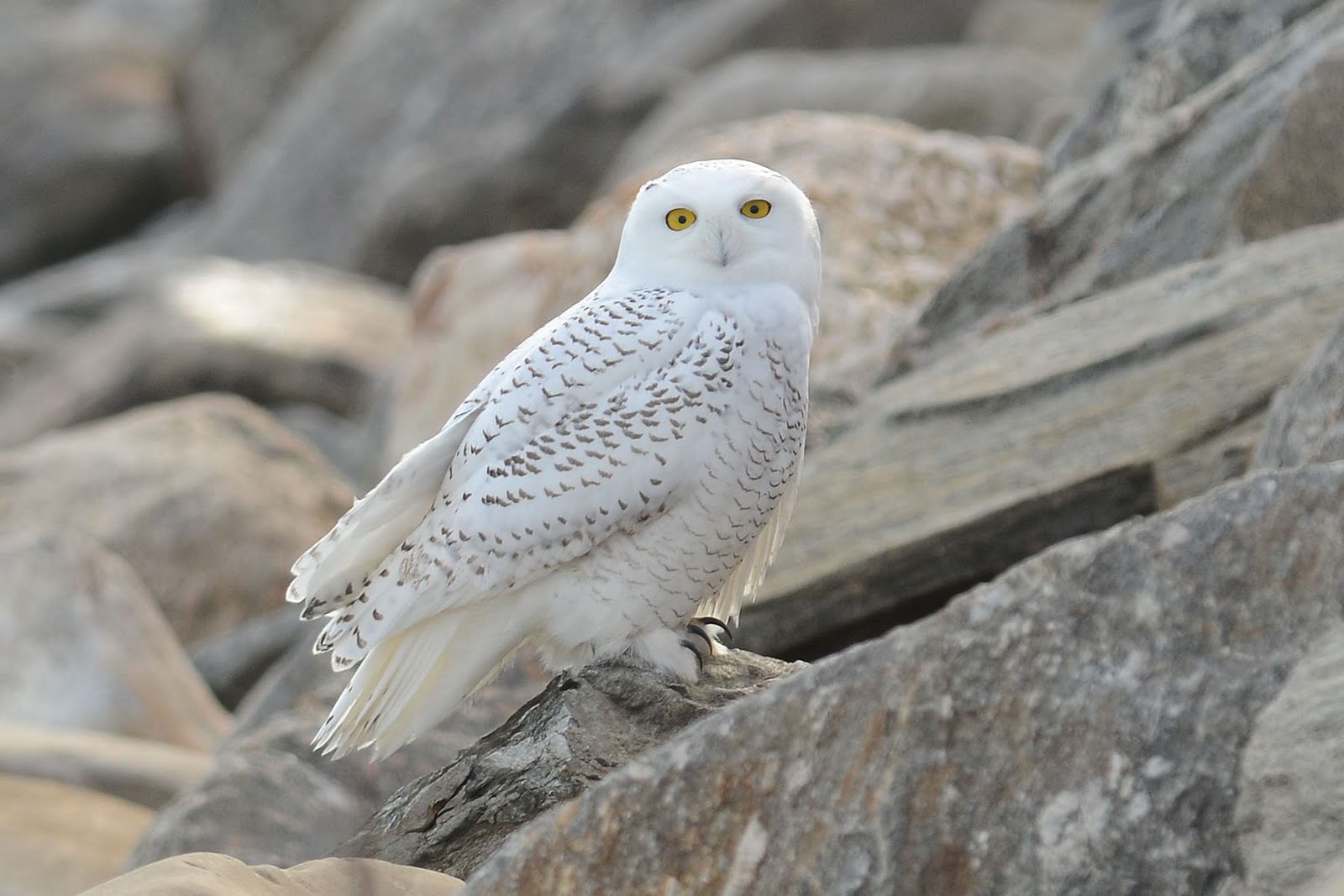
Snowy Owl at Stratford Point

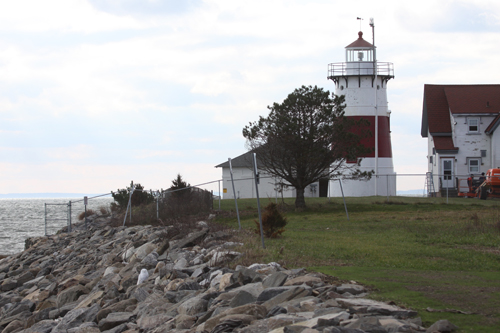
During a waterfowl survey at Stratford Point this morning I came upon a Snowy Owl sitting on the rock revetment wall on the Long Island Sound side, not far from the lighthouse. It was resting out of the strong west wind, away from the maintenance work at the lighthouse and dune construction at Stratford Point. It sat there, barely moving, for over two hours, admired by birders and non-birders alike, only fully waking up and moving around some because of noise from the lighthouse. It flew from rock to rock, perhaps also interested in catching a snack there, too. Here are a bunch of photos and then HD video I took of it.


Yawning!
It was dozing off from time to time


 After it moved closer to the water


 Blends in so well


The HD video! (also available here)


Here are some of Twan's magnificent photos...those eyes and talons!


And a few from Frank Mantlik...


 Relative location to the lighthouse


Check out this timely eBird article on the big fall and soon to be winter Snowy Owls have been having and to learn more about the species! http://ebird.org/content/ebird/news/got-snowies

Stratford Point is an excellent spot for them as it provides an open habitat full of small mammals. This was such a cooperative bird, allowing great looks for everyone who visited while we gave it enough room so as not to stress it out. It may stick around a few days or it may move on tonight - we will have to see tomorrow. If you visit and cannot find it, walk slowly and quietly to the revetment wall surrounding the site. Look along it and out on the breakwater in the mouth of the Housatonic, and check any perches, from trees to poles.


Scott Kruitbosch
Conservation Technician

Video © Scott Kruitbosch; Photos © Scott Kruitbosch, Twan Leenders, and Frank Mantlik

Tuesday, November 29, 2011

More late November birds

Connecticut Audubon Society Coastal Center Director Frank Gallo sent me the following on another apparently record late bird and still more from the migrant trap that is East Shore Park in New Haven...

Patrick Dugan sent me these photos of a Philadelphia Vireo that he took in Newtown on the morning of November 28th. It's the latest New England record by at least a week. There was a Maine record this year around November 17th and one in Massachusetts around November 7th. October 11th is about Connecticut's latest previous record...amazing!


Here are record photos of three of the five species of warblers I found at East Shore Park this afternoon (November 28). There was one Palm (western), one Tennessee (very late), two Nashville (one bright, one dull), a Common Yellowthroat (probably a young male), and a new one for the list, Yellow-breasted Chat (so long as we still call the debated bird a warbler). They showed up around 3:30 p.m. down by the harbor in the tall vine tangle and behind it along the fence. We've now documented 13 warbler species for the park this November.


 Tennessee Warbler

 Common Yellowthroat

 Yellow-breasted Chat


Scott Kruitbosch
Conservation Technician

Monday, November 28, 2011

Name this bird answer

Have you been able to come up with the right species in the latest photo quiz, "name this bird"? It is one you could find in Connecticut in the fall, winter, and early spring. It may look brown in the photo, but it has a difference appearance come breeding season. It likes to pick at weeds and grass for seeds along driveways and areas of gravels at times like is shown in the photo, though it is very comfortable in the middle of a field, farm, dirt patch, or beach.

It is...


...a Snow Bunting! They can be tough to find outside of a very open space, but two good places to see them in Connecticut are our Coastal Center at Milford Point and Stratford Point. They have been especially common at the latter feeding on grass seeds that were replanted in some areas after repair work was completed on the seawall after Irene. If you walk the perimeter of the site, especially near the path to the Long Island Sound side, you may see them quietly feeding on the ground, anywhere from a couple to several dozen. I saw three right there this past Saturday.


Scott Kruitbosch
Conservation Technician

Friday, November 25, 2011

Snow Geese flying by Stratford Point

We all have some sort of nemesis bird or birds, whether it is a species you have yet to add to your life list or one that you have not seen in a long time and "should" have at some point. After literally hundreds of hours spent hawk watching at Boothe Park in Stratford, besides thousands of other hours of survey work, I had not seen any Snow Geese, not one Goose, since a group of around 75 flew over our heads at Boothe on November 2, 2008. Thankfully, while I was inside at Stratford Point Wednesday afternoon, our friend Frank Mantlik was outside scoping Long Island Sound and called me out of the office when he found a large group of around 115 Snow Geese coming off the Sound.

They were heading north through the low level clouds of the system that was still clearing to our east. They were probably lost in the rain and rapidly moving cloud deck, finding themselves over water and now resetting their course. They came directly over Stratford Point heading north, then east, then west, and then north again. Getting back on track wasn't easy for that lead bird, but I am sure they found their way eventually. I did not have my camera when they came directly over (naturally, this often helps you find birds!) but I grabbed it out of my car as they moved away, snapping a few photos of them bending this way and that way through the sky.


Take a look at the shot below that I left a little larger so that you can see the details of some of the geese a bit better. While I was unable to pick out a Ross's Goose from the lines, I did pick out what looks like a juvenile blue morph Snow Goose, highlighted in the red box.


Apart from ticking off the species for the first time in three years, I was so glad to have them at Stratford Point. The only other time we had the species there was also the third week of November. I guess it is time for me to find another nemesis bird...


Scott Kruitbosch
Conservation Technician

Wednesday, November 23, 2011

Name this bird

Take a gander at the latest subject of our photo quizzes and every detail in the shot below. See if you can identify this bird that you can spot in the appropriate habitats around this time of year. Where it is and what it may have been doing in the photo will definitely help you.


Good luck! And Happy Thanksgiving! The answer will be coming on the weekend.


Scott Kruitbosch
Conservation Technician

Monday, November 21, 2011

Embed photos in eBird

The people at eBird have come out with another great feature to tempt you in to using the database while also helping those of us who are already addicted to it. You can now embed photos into your checklists!

"We are excited to report that it is now possible to embed photos within checklists! This not only makes the checklists look more attractive, but also makes it easier for reviewers to review and confirm your rare sightings. These images will be viewable in eBird checklists (accessed via My eBird and point maps), in eBird Alerts online, and will be accessible to eBird reviewers, making their job much easier."


Please check it out in full detail here: http://ebird.org/content/ebird/news/embed-photos-in-your-checklists

That link provides some very cool examples, guidelines for embedding your photos in your checklists, how to link to them via outside sources, and even how to include a link to sound or video which I hope will be able to be put directly into lists in the near future. This feature is not only useful for those people who verify rare birds on checklists submitted to eBird but to anyone who wants to help remember a day in the field, correlate their photos to their data, or share everything with a friend.

Please keep using eBird as much as possible! Later this week I will provide an example of what one can do quickly and easily with all of the data now being entered on a daily basis.


Scott Kruitbosch
Conservation Technician